


Over the past year, I’ve been observing how organizations and leaders are responding to the rapid rise of AI. There is excitement, curiosity, and often pressure to “do something with AI.” Many leaders feel the need to move quickly, while some are still trying to understand what this really means for their people and business.
What I see today with AI feels familiar. It closely resembles the early stages of agile transformations, where enthusiasm for new tools and practices often came before clarity on purpose and outcomes.
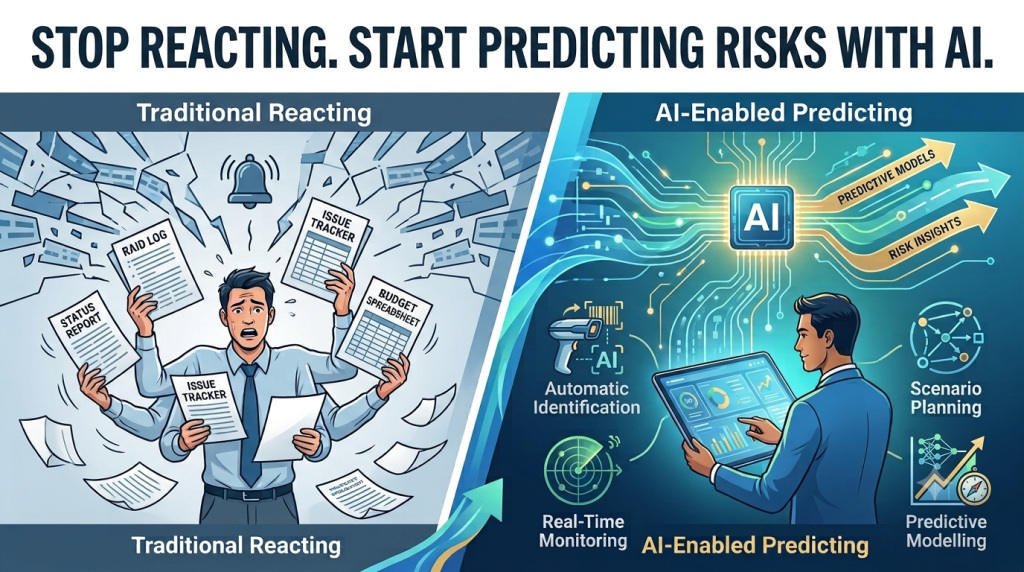
Much of this urgency is driven by AI hype — the belief that adopting AI tools will automatically lead to business value. Similar to early agile transformations, this tool-first approach often creates activity without meaningful outcomes, leading to scattered pilots, confusion, and disappointment. Recent research shows that a large majority of AI pilots never reach production or create meaningful value, even though most companies are now experimenting with generative AI in some form.
Why Tool-First Thinking Fails
From my background in Delivery Excellence and agile transformation, one principle stands out clearly:
Success with AI doesn’t begin with technology. It begins with a mindset shift. That mindset shift is simple but powerful:
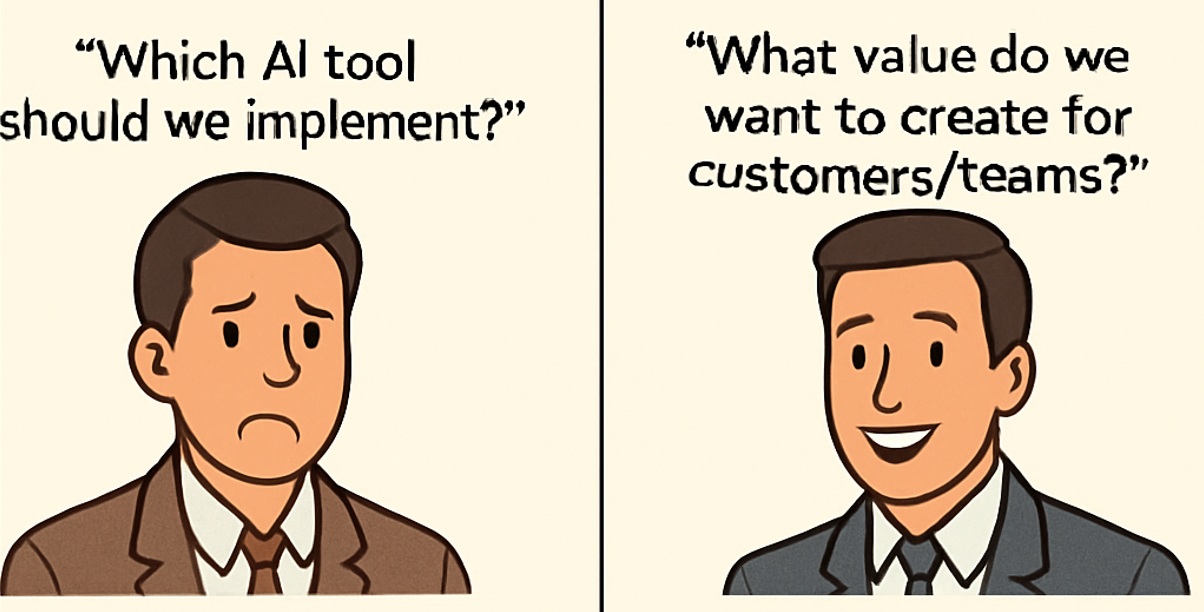
From: How do we use AI?
To: Where do we create value using AI?
Just as in agile transformations, starting with tools or practices leads to shallow adoption. When teams begin with questions like:
- Which AI tool should we implement?
- What can ChatGPT do for us?
- Should we automate this process?
they often fall into solution-first thinking. This typically results in:
- Scattered pilots
- Low ownership
- Minimal business impact
- Employees feeling unsure or threatened
- A perception that “AI didn’t help us much”
The shift toward value-first thinking mirrors the same shift that enables agile teams to succeed.
Why This Mindset Matters — A Leadership Perspective
- It anchors AI efforts to business value
This shift brings the “why” before the “how.” Tools evolve and frameworks change, but value drivers — customer experience, flow efficiency, and waste reduction — remain stable anchors for decision-making. - It creates shared understanding across teams
One of the biggest challenges in any transformation is alignment. When AI conversations remain tool-centric, only a few people can participate meaningfully. When conversations shift to value, everyone can engage:- What challenges slow us down today?
- Which decisions take too long?
- Where are customers getting stuck?
- Which tasks consume energy but create little value?
- It reduces resistance by focusing on purpose, not threat
In change coaching, we know people don’t resist change — they resist loss of control or loss of relevance. When leaders say:
“AI will help remove repetitive work so you can focus on meaningful outcomes,”
instead of:
“We are automating this process,”
the emotional response shifts significantly. Psychological safety becomes an enabler of AI adoption — just as it is for agile teams. This is not a communication challenge; it is a leadership responsibility.
What This Looks Like in Daily Leadership Practice
Instead of saying:
“Let’s use AI in customer service.”
Ask:
“What value do we want to create for our customers — faster responses or more personalised interactions?”
Instead of:
“We want AI in development.”
Ask:
“How might we improve flow or reduce bottlenecks so teams can innovate more?”
For example, one product group discovered through a simple time audit that around 20% of their week was going into creating and updating status reports. Instead of starting with, “Which AI tool should we buy?”, they asked, “What outcome do we want?”. The answer was: “Free up at least half of this time so teams can focus on delivery and problem‑solving.”
Together, they ran a small experiment. They standardized their status report format, connected existing project tools, and used an AI assistant to generate first‑draft reports that managers only had to review and refine. Within a few sprints, they had cut status‑reporting time by more than half, and leaders decided to scale the approach to neighbouring teams. The win wasn’t “we used AI”; the win was measurable: more time for real delivery work, less energy wasted on low‑value documentation.
This aligns AI initiatives with the same principles that drive successful agile transformations: focus on outcomes, inspect and adapt, empower teams, and experiment small.
A Simple 3-Step Starting Point for Leaders
- Clarify the top 2–3 value outcomes
Treat these as your north stars — similar to agile product goals. - Map pain points and opportunities collaboratively
Co-create insights with teams to build ownership and uncover practical use cases. - Run small experiments instead of big programs
Just as in agile, progress comes from short learning loops, not large upfront plans.
If you are looking for guidance on adopting AI in the right way, feel free to connect with us at PM Power Consulting. We would be happy to support you in making your AI adoption journey smoother and more effective.
Below are links to a couple of PM Power Consulting articles that you may find useful:
https://www.pm-powerconsulting.com/blog/ai-for-the-enterprise-picking-the-right-horse-for-the-course/
https://www.pm-powerconsulting.com/blog/from-dot-com-to-ai-six-lessons-for-every-leader/
Closing Thought
The organizations thriving with AI today aren’t necessarily the most technologically advanced.
They are the ones where leaders think differently:
Start with value. Build psychological safety. Empower teams. Learn in small steps.
That’s where the success with AI begins.