



When it comes to higher levels of planning like road-mapping or release planning, product management has the responsibility to determine the order of work items for delivery teams. In my opinion, product owner is one of toughest roles in the agile world. Product management teams have always had to deal with market dynamics and customer expectations and that will continue to be their key challenge. In pre-agile era, feeding the delivery teams was governed by well-defined and mature requirement and scope management processes. This is not to say that product owners were happy with those processes. It was hard for them to respond to changes in the market and customer dimensions. In the agile world, these processes have been replaced by practices that keep value flowing and is more a continuous and more granular process. In pre-agile era, there were clear rules of engagement and defined processes for how work is fed to delivery teams. I feel in the agile world that we live in, these structures are still evolving and maturing. There is no shortage of ideas from consultants and gurus, though.
Landscape is different in a software product organization and in an enterprise IT setting. Let us take an enterprise IT setting for this post. I started jotting down what may be worthwhile ideas in an enterprise IT setting and what I had preached in different organizations as a consultant. My first reaction to the list was one of shock! Some are techniques, some are considerations for prioritizing, and some are just constraints for ordering work. It is the length of the list that shocked me more than anything else. I soon felt remorse for the plight Product Owners had to endure in my hands! Here is the list so you can relate to what I am feeling.
- Priority from each stakeholder
- Scheduling for completion (stop starting and start finishing)
- Dependencies
- Utilization and skill set constraints
- MVP/MMP/MMR aided by story mapping technique
- Enterprise strategic themes
- Kano model of prioritization
- Uncertainty matrix – value/risk
- Eisenhower Matrix – importance vs urgency
- Prioritizing within investment themes
- Prioritizing within value streams
- Prioritizing based on business/system capability roadmap
- Prioritizing within classes of service
- MoSCoW
- Relative Weighting prioritization technique
- Enterprise architectural priorities
- Cost of Delay & WSJF
- User Personas and Journey Mapping to prioritize work
- Team preferences and ideas for leveraging new technologies
- …..
There must be a way to simplify the message to the Product Owners and help them do their job well. Here is my 3P+2S method for ordering work.
I always recommend to POs to split the process of ordering work items into two steps:
- Prioritization
- Sequencing
3P for Prioritization
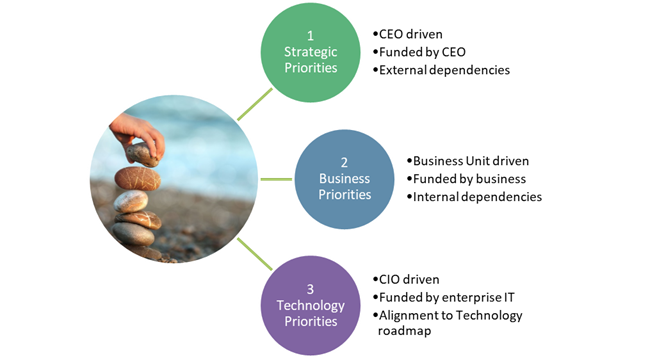
POs need to separate all the work items thrown at them into three different tracks for Prioritization:
1. Strategic priorities
2. Business Unit priorities and
3. Technology priorities.
It is difficult to order work across three groups. If you can prioritize across these, go for it. It is always best to have a single list of priorities. However, it is practical to have three lists of priorities and allocate capacity across these three tracks in collaboration with the delivery teams.
2S for Sequencing
I feel sequencing requires only two considerations:
- Dependencies
- Stop starting and start finishing for delivery of outcomes
Internal dependencies within your scope of work is relatively easy to manage. External dependencies pose a greater risk and you need to collaborate with external units with support from your leadership as required.
In conclusion…
Context in every organization varies and Product Owners are expected to set the pace for the delivery teams and pressure is on them to maximize business value and get the best return for the investment. Strategic alignment is difficult to achieve – given the ‘distance’ between enterprise strategy and a delivery team traversing through layers of management that are going through a ‘what-is-my-role-now-crisis’. Such alignment may be difficult to achieve but it is possible and definitely worth striving for. My recommendation for Product Owners: Do not get stuck on techniques of prioritization but focus on 3P+2S method outlined above. That will help optimize the flow of value.
I highly recommend this blog by my colleague Chitra as it provides excellent guidance to Product Owners: https://pm-powerconsulting.com/blog/a-key-skill-for-product-managers/