



In my Agile workshops I ask participants a question: ‘What pictures come to your mind, when we talk about Agility?’ Some of the typical answers are Cheetah, Squirrel or Dolphin etc. Then I ask them what aspects of them relate to Agility in their mind? Typical responses are that they are quick, fast, swift, they flow, adopt to change quickly and so on. As we deliberate in the class further about what is Agility, it emerges that Agility is about how quickly the entity senses the environment and responds back.
Essentially Enterprise/Business Agility is about Sense & Respond – how quickly the organization Senses the Market/Customer/Consumer/Competition and Responds with solutions. This requires openness & empathy in people to sense the needs, adopt to changes, collaborate through the value-streams, deliver innovative solutions and respond to feedbacks swiftly. Organization has to function like an Organism.
This end-to-end sense and respond mechanism requires multiple aspects to be addressed under People-Process-Technology triad. This blog-post will explore the mindset and culture aspect needed for Agility under People dimension.
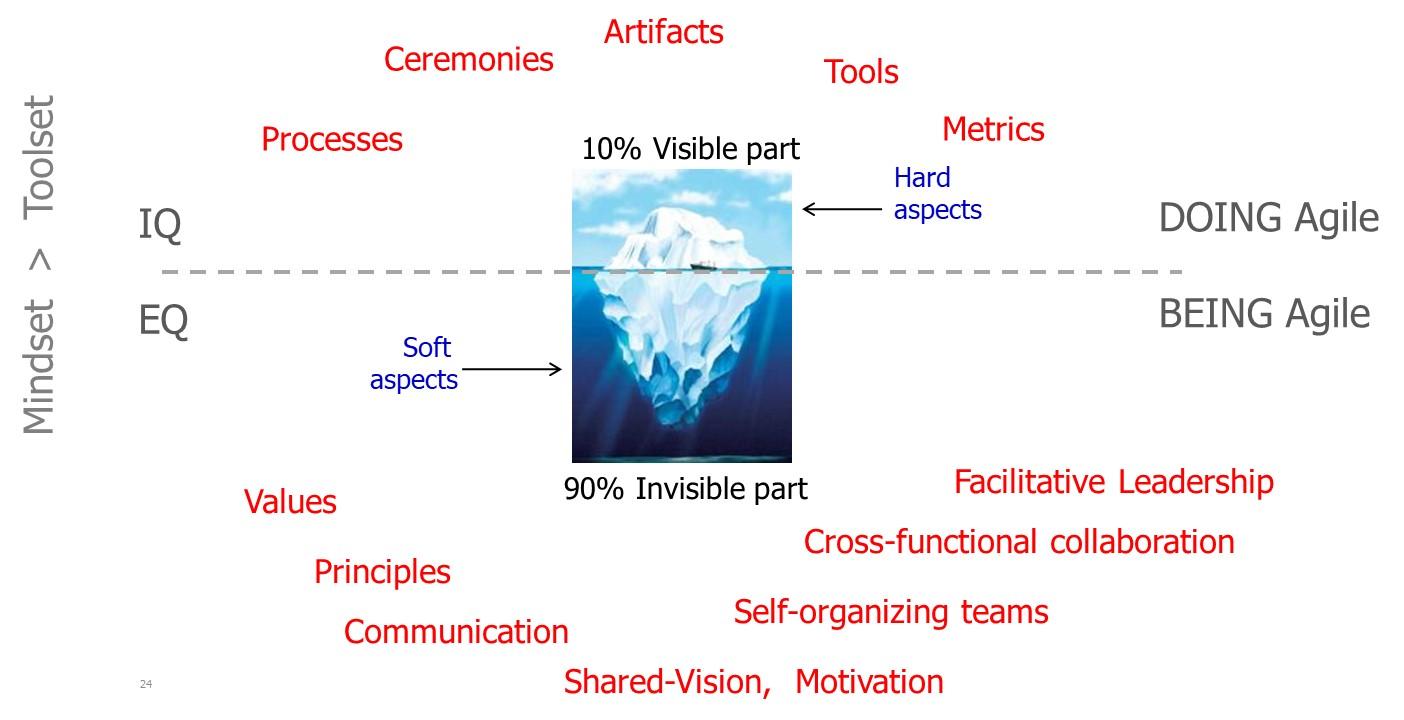
Another question I ask in the Agile workshops is ‘what makes Agile succeed?’ and I take the Iceberg metaphor to make a point. Typically 10% of iceberg is visible and about 90% of the iceberg is submerged under the water. Iceberg moves not because of the visible wind outside, but because of subtle, not-so-visible undercurrents in the water. In a similar way, critical success-factors for Agile projects is not so much the visible aspects like process, tools, metrics, ceremonies, artefacts but not-so-apparent factors of behavior, culture and mindset – it is about BEING Agile beyond just DOING Agile.
The critical success factors for agile Culture are Servant/Facilitative Leadership, Cross-Functional Collaboration and Self-Organizing Teams. The This is the realm of Emotional Intelligence (EI/EQ) as depicted in the below diagram.
Mindfulness is a practical way to develop Emotional Intelligence
Mindfulness is about being in the Present moment with full Awareness of what is happening within oneself (thoughts, feelings, emotions) and outside (situations, people) and Responding wisely & consciously rather than Reacting compulsively.
Download our free eBook on “Mindfulness@Work – Managing Outside by Mastering Inside” to understand about Mindfulness techniques, its effects and evidences of neuroscience research.
As the neuroscience researches confirm, Mindfulness practices help to enhance EI by transformations in brain cells, nervous system and endocrine systems, there by making people more self-aware, self-regulating, self-motivated, empathetic and more socially skilled.
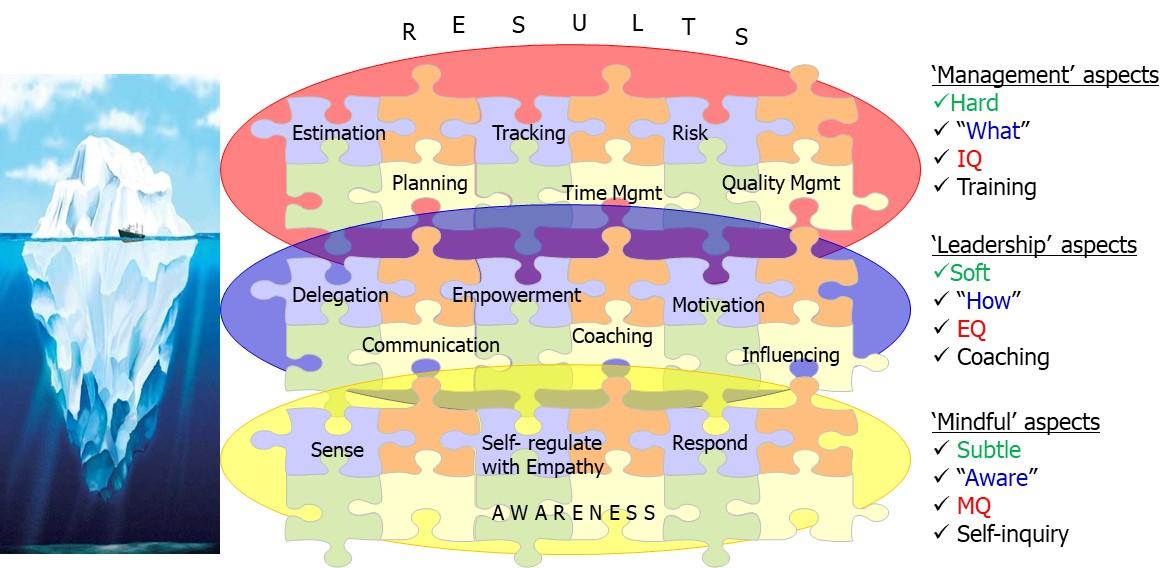
Back to the iceberg metaphor – this diagram shows how IQ, EQ and MQ (Mindfulness Quotient) stack up. At the outcome level, we want to get business results, for which we plan and execute several activities – these are at the top of the iceberg, visible, IQ oriented. Beneath the water level are the not-so-visible soft aspects which are EQ oriented. Mindfulness is at even subtler level, impacting the outcomes deeply.
Mindfulness is gaining more and more prominence in many organizations as part of Agile Transformation and Leadership Development initiatives, especially after Google’s “Search Inside Yourself” program.