


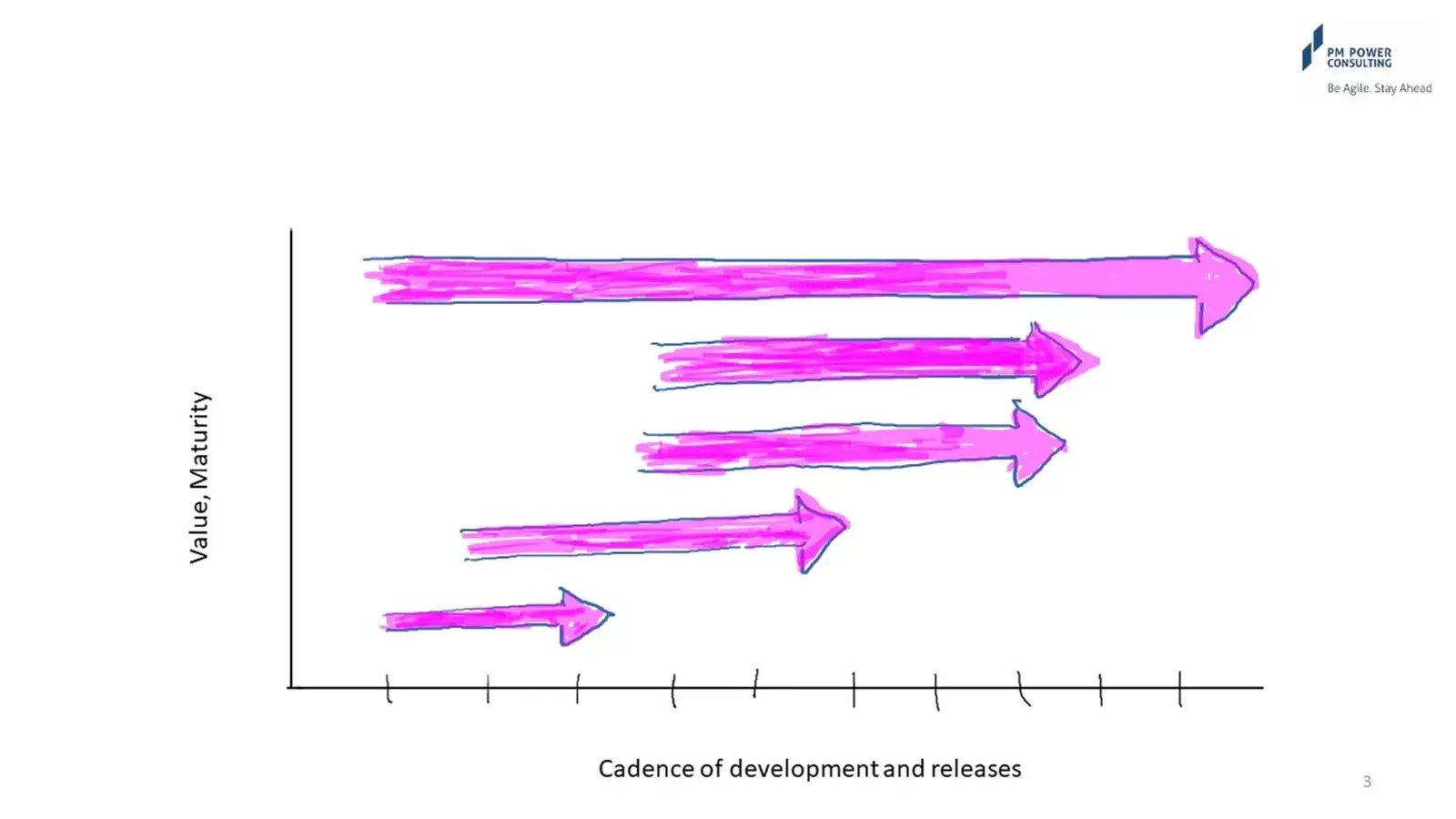
Victor seemed to be immersed with some chart on his desk and fully focused on that, when Bardhan walked in.
Bardhan saw some parallel arrows drawn on the chart and the axes marked as Value, Maturity on the Y dimension and Cadence of development and releases on the X dimension.
Curious, he asked Victor what it was.
Victor said that this was a picture he had noted down from a recent coaching session on bringing in some refinements and improvements in his team. He also had some labels on the page [see below] but had forgotten which label is related to which row.
Wow, said Bardhan. This is a good puzzle to solve, right after lunch! But, tell me, Victor, do you remember any other messages from the session, that would give us some clues?
Victor thought about it and said that I vaguely remember something like this. I had noted a few points, but had paraphrased what I heard in my own words. I forgot to attach them to these arrows.
The team needs to embrace the culture of the to-be state in order for anything else to work.
We should be starting with a clear purpose and everyone should know their own responsibilities as individuals as well as how they would work as a team.
They should also be clear about how they will work as a team, with appropriate norms and have a clear idea of how to plan and manage their work together.
With that clarity, they can then start experimenting and exploring good engineering practices and focus on the product quality – or, in other words, the quality of the workproducts created by the team.
The fifth theme was the culture of empiricism and using data for learning and planning [as well as tracking].
All these, while parallel, have some time lag or sequencing, to ensure that we can build on the earlier themes, that will help sustain the improvements.
Can you help Victor and Bardhan complete the picture below?
Suggested Solution:
Solve the picture puzzle below. Drag the labels to the respective arrows and check your answer. If you get something wrong, you can try again.