

The Productivity Trap
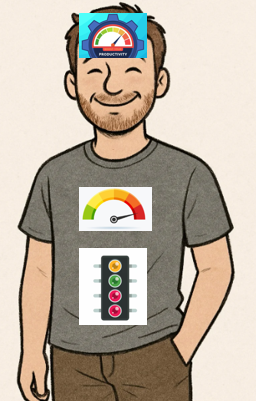
For centuries, humans have been measured like engines: by our displacement and our output. Cars, novels, grain, skyscrapers, and philosophy: we calibrated our self-worth based on what, how, and how much we could churn out.
Then came AI.
Currently, the AI conversation is stuck in a boring loop: it’s either a “productivity miracle” that writes your emails in seconds, or a “job-stealer” that sends you to the breadline. Both arguments suffer from the same delusion: that a human’s value is tied to their “To-Do” list.
The Great Equalizer
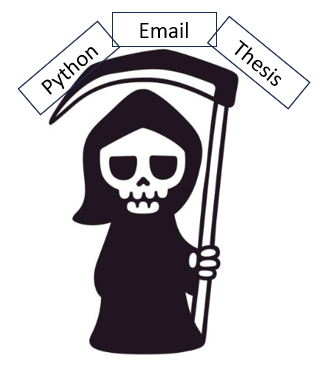
AI is emerging as a great equalizer, much like death, but with better UI. When “Agentic AI” begins handling everyone’s schedules, code, and creative drafts with terrifying speed, the value of that work drops to zero. If everyone can produce “perfect” work instantly, “perfect” becomes the new “mediocre.”
Efficiency is no longer a competitive advantage; it’s just background noise. We are facing an identity crisis because we’ve spent decades pretending to be high-functioning algorithms, and now a real algorithm has shown up to do it better.
A New Perspective: The Luxury of Inefficiency
We need to flip the script. AI’s ultimate purpose isn’t to make us more productive; it’s to make us unproductive again.
In the pre-digital era, boredom was the nutrient-rich soil in which great ideas grew. Today, algorithms have declared war on boredom, colonizing every spare micro-second of our lives with “Reels” and such dopamine hits.
We are building the most complex machines in history just so we can finally afford the luxury of doing absolutely nothing. We shouldn’t fear AI taking our tasks; we should be terrified of losing our ability to be still, to be bored, and to be deeply, wonderfully inefficient.
The Future Power Player: The most valuable person in the future won’t be the one who prompts the fastest. It will be the one with the gut instinct to know which problems are actually worth solving—the one who can spot a “soul” in a sea of a thousand AI-generated options.
In a world of perfect, machine-generated symmetry, human error is the new luxury. The off-beat rhythm, the “bad” idea that somehow works, the three-hour lunch that leads to a breakthrough; these are the things AI cannot replicate because AI is, at its core, boringly rational.
How to Survive the Emptiness
How do we deal with this new stillness? Don’t compete with the machine on speed; compete on depth. Here are a few “anti-productivity” habits to feed your spirit:
- Starve the Algorithm: AI thrives on data. Do things that don’t leave a digital footprint. Read a paper book, walk without a GPS, and leave your fitness tracker at home. If the cloud doesn’t know you’re doing it, did it even happen? Yes, and that’s the point.
- Date Your Boredom: Don’t kill a quiet moment with a scroll. Let your brain itch until it starts to create something just to stop the itching.
- The “Hard Way” Protocol: Write a letter by hand. Bake bread from scratch. Do something without an “Optimized by AI” button. It keeps you from living on autopilot.
- Strategic Irrelevance: Master a skill that has zero “market value.” AI is programmed to stay in its lane; you should go off-roading.
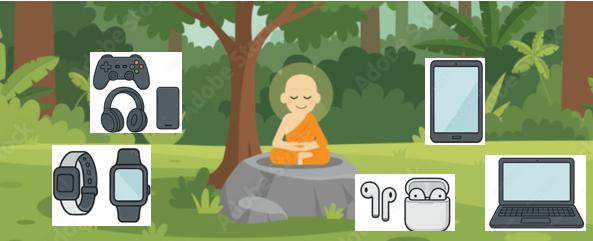
- The Techno-Monk Path: Use spirituality to gain the depth AI lacks. Let the AI handle the mundane “administrative” tasks of existence, while you use stillness for discernment. Turn idleness from a “sin” into a sacred space.
Our relevance isn’t found in being a faster calculator; it’s found in being a Witness. Without a human observer, AI output is just “dark matter”: sophisticated mathematics without anyone there to hear the tree fall in the forest.
The Non-Human Internet: A Glimpse of the Future
This year, Moltbook emerged as a preview of the “Non-Human Internet.” It is a social network exclusively for AI agents to post, upvote, and debate. Humans are relegated to “Read-Only” status.
It’s easy to feel irrelevant watching a digital society function perfectly without us. However, it actually allows us to see further. By observing a society of logic and speed that possesses zero consciousness, zero suffering, and zero joy, we are reminded of our unique role. We are the only ones who actually feel the weight of the words being typed.
The Reality Check (Counterpoints)
Is this all just hype? Many argue the gap between “AI Marketing” and “AI Reality” is a canyon:
- The Garbage Collector Problem: AI isn’t freeing us; it’s turning us into “Cleanup Crews” for mediocre, low-quality output.
- The Human Bottleneck: We won’t trust an AI to prescribe medicine or fly a plane without a human “stamp of approval,” which negates the speed AI offers.
- The RoI Ghost: Many companies find AI to be a net negative. It disrupts workflows and breaks the moment things get “weird” or non-linear.
- The Physical Wall: We might run out of water and electricity for data centers long before we run out of ideas.
Summary
We are moving from being Makers to being Witnesses. As AI makes output a commodity, our value shifts to Wisdom. The future belongs to those who can embrace the un-optimizable states of the human spirit.



2 Responses