


Continued from Full Stack Leadership – Upcoming book from PM Power – Post III
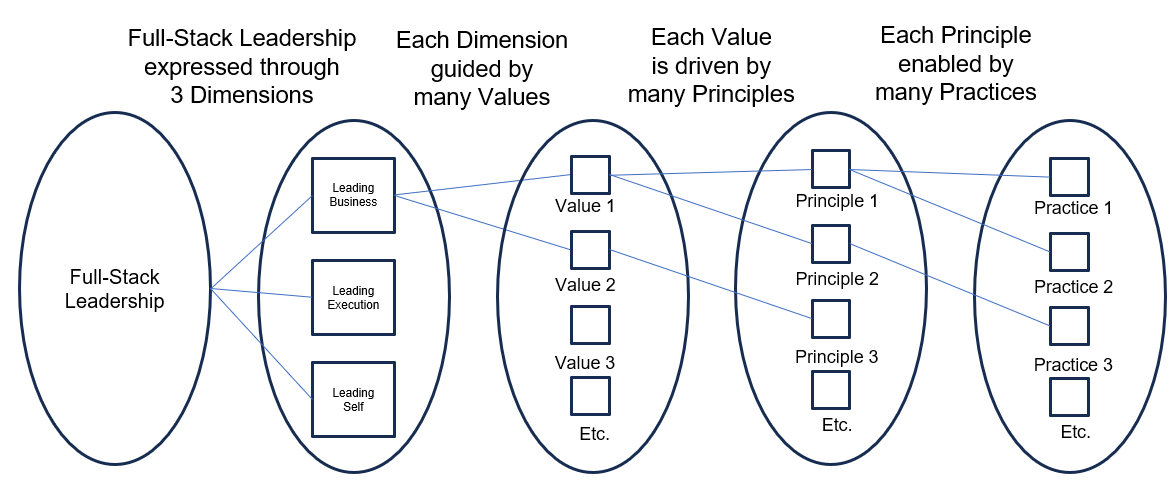
In a previous post we saw that in the book we discuss the the three dimensions of full stack leadership – namely Leading Business, Leading Execution, and Leading Self. In that post we briefly looked at what these three dimensions were.
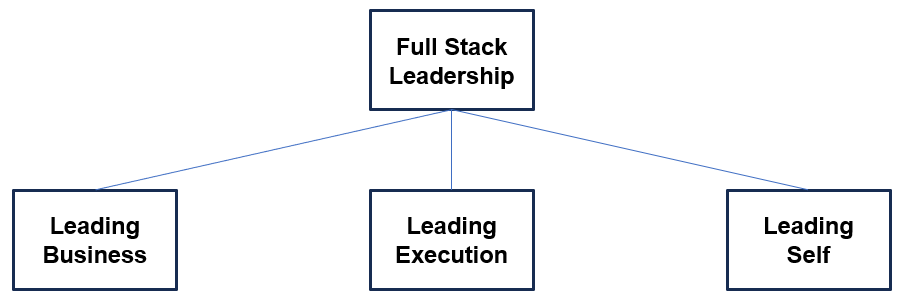
We said that Leading business entails creating an environment where the organization is able to understand, adapt and respond to the changing marketplace and market needs, customer asks, and competitor moves; Leading execution involves taking ideas put forward by the business and creating value with it– value for all stakeholders including customers, associates and shareholders; and Leading self refers to the ability of an individual to effectively manage and direct their own actions, behaviours, and emotions.
In the same post we also said that for each dimension of leadership, the book identifies a set of values (beliefs and ideas) which should be internalized by leaders when they exercise their leadership.
The book also identifies a set of principles that drive these values. Principles of leadership are objective truths that determine the outcomes of leadership behaviour. And for each principle, the book identifies a set of practices, or regular behaviors and actions, that needs to be followed by the leader to enable that principle fully.
The three dimensions are summarized in the following table:
| Full-Stack Leadership | Leading Business | Creating an environment where the organization is able to understand, adapt and respond to the changing marketplace and market needs, customer asks, and competitor moves. |
| Leading Execution | Taking ideas put forward by the business and creating value with it– value for all stakeholders including customers, associates and shareholders. Execution here means much more than development and implementation. | |
| Leading Self | The ability of an individual to effectively manage and direct their own actions, behaviours, and emotions. Effective leaders must first be able to lead themselves before they can effectively lead others. |
In the next three posts, we look and summarizing what the book talks about about these three dimensions.
Continued in Synopsis of Full-Stack Leadership – Upcoming book from PM Power – Post II- Leading Business
Note:
The following posts together give a complete summary of the new book from PM Power – Full-Stack Leadership
- Background and introduction to the book – 1
- Background and introduction to the book – 2
- Background and introduction to the book – 3
- Synopsis of the book – Introduction
- Synopsis of the book – Leading Business
- Synopsis of the book – Leading Execution
- Synopsis of the book – Leading Self
- Synopsis of the book – AI
- Endorsements
The book is available for purchase at the sites mentioned below.