



Is your team aligned, or are they just silent?
First, measure the Sound of Silence: Take the “Silence Audit“, a 5-minute diagnostic to measure the “Decibel Level” of truth in your organization.
Then read the following article:
The Sound of Silence
The corporate world is obsessed with noise. We mistake ‘shouting’ for ‘strategy’ and ‘busyness’ for ‘business.’ But while organizational leaders are screaming for results, the real data is dying in the Sound of Silence. Leadership bosses shriek and scream about communication, but they rarely study the heaviness of what isn’t said. But the deadliest metric in your organization could be the Sound of Silence. We’ve been taught that a “quiet office” is a focused office. We’ve been told that a harmonious meeting is a sign of alignment. Well, we were lied to. In the world of organizational and leadership excellence, silence isn’t golden. It’s expensive. It’s the sound of a looming success debt [Success Debt is the ghost in the machine. It’s what happens when you win so fast your culture can’t keep up. It’s the invisible tax on your future excellence.] that no one is brave enough to call out. When the air goes thin in a boardroom, it isn’t because everyone agrees: it is because they’ve stopped trying to disagree.
Let us first look at some of the symptoms of this problem.
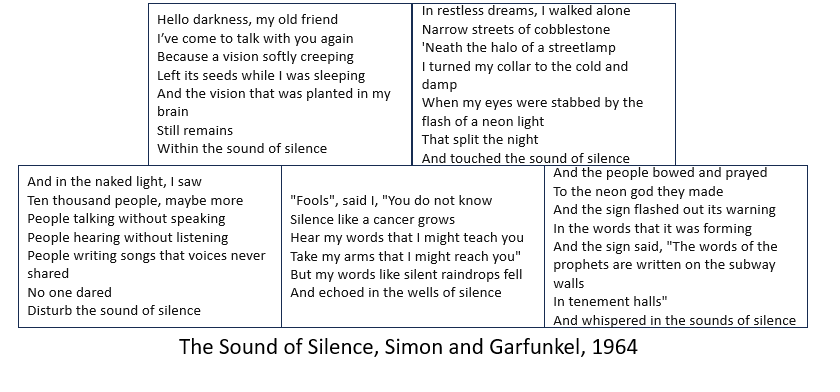
1. “Hello Darkness, My Old Friend” (The Comfort of Avoiding Conflict)
Organizational silence usually begins with a “friend.” We don’t want to hurt a colleague’s feelings. We don’t want to “derail” the momentum of a project. So, we let a flawed assumption slide.
But silence has a compounding interest rate. Every time a team member thinks, “It’s not worth the argument,” your organization loses a piece of its immune system. Excellence isn’t the absence of noise; it’s the presence of productive friction.
2. “People Talking Without Speaking”
Have you ever sat through a 60-minute “sync” where everyone used the right buzzwords, nodded at the right slides, and said absolutely nothing of substance? This is performative alignment. This is high politeness metrics, but low problem-solving velocity. The reality is that the real meeting happens in the 1:1 DMs or at the coffee machine afterward. If the “real” conversation isn’t happening in the room, your leadership has failed to create disinformation security or a process for protecting an organization’s decision-making process from being corrupted by internal disinformation, which is usually the unintentional (or intentional) filtering, spinning, or withholding of bad news.
3. “Hear My Words That I Might Teach You”
True organizational excellence requires a vulnerability audit. If your team is silent, it’s usually for one of two reasons: Acquiescence: “Nothing I say will change the outcome anyway”, and Quiescence: “If I speak up, I’ll be labeled a ‘blocker’ or ‘not a team player.’”
When people stop “disturbing” the sound of silence, they have officially checked out. They are no longer stakeholders; they are just passengers.
The Takeaway
Simon and Garfunkel’s “vision that was planted in my brain” only grows if it’s challenged by the light of day. If your organization is too quiet, you aren’t achieving excellence—you’re just waiting for the crash.
Shattering the Sound of Silence
Here are some non-traditional techniques to shatter the sound of silence.
1. The “Pre-Mortem” (Institutionalized Pessimism)
Most teams do a “Post-Mortem” after a project fails. By then, the silence has already done its damage.
- The Technique: Before a project starts, gather the team and say: “Imagine it is one year from today and this project has been a total disaster. What happened?”
- The Excellence Result: This gives people “permission to be negative.” It turns dissent into a creative exercise rather than a social risk. It protects Mindshare by identifying risks before they become mental clutter.
2. “The Empty Chair” (The Ghost of the Front Line)
The “Sound of Silence” often happens because the people in the room are too far removed from the actual work (the “Subway Walls”).
- The Technique: In every high-level strategy meeting, leave one physical chair empty. That chair represents the junior-most employee or the most frustrated customer.
- The Excellence Result: Throughout the meeting, leaders must ask: “What would the person in that chair say about this decision?” This forces Mutuality by ensuring the “Neon God” of corporate metrics doesn’t drown out the reality of the front line.
3. Radical “Closing the Loop” (The Anti-Vacuum)
Silence grows when people feel their words “like silent raindrops fall.” If I give feedback and nothing happens, I will never give feedback again.
- The Technique: Create a public “Feedback Tracker.” Every time a suggestion is made (even a bad one), it must be logged with a status: Implemented, Under Review, or Rejected (with a 2-sentence ‘Why’).
- The Excellence Result: This builds Mutuality through transparency. People don’t mind being told “No” as much as they mind being ignored. It proves that speaking up has an impact on the system.
4. “The 10% Vulnerability” Lead
If a leader is perfectly polished, the team will remain perfectly silent.
- The Technique: At the start of a project or quarter, the leader shares their own “10%.” This is the 10% of the plan they are most unsure about, or the mistake they made in the last month that they are still learning from.
- The Excellence Result: This shatters the “Neon God” of the infallible leader. It signals that the organization values truth over optics, freeing up Mindshare that was previously used to maintain a “perfect” facade.
5. Other approached to break the silence?
- celebrating the dissenter: At the end of every meeting, ask: “Who has the strongest argument against this plan?” Give a prize for the best “Red Team” thinking.
- measuring the unsaid: Conduct anonymous post-meeting pulses. Ask one question: “On a scale of 1-10, how much of your internal critique did you leave unsaid today?”
- killing the “Nice” culture: Replace “Being Nice” with “Radical Clarity.”



4 Responses
Simple, profound and amazing insights, as always Vishu
Thanks Sushma.
Liked every line of it, thanks for sharing it.
Thanks Basavaraj. Glad that you liked it.