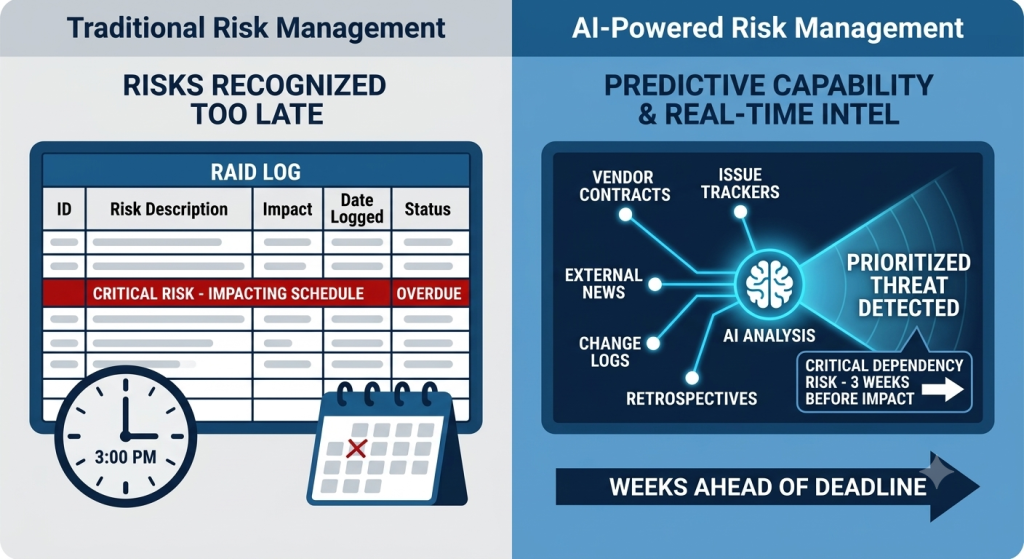




There is no shortage of buzz around AI today. New tools, agents, and platforms seem to appear every week, each promising dramatic productivity gains. For Program Managers, this creates a familiar problem: a lot of noise, very little clarity. Program Managers are responsible for enabling fast, sustainable execution at scale. Their work focuses on sense-making, coordination, decision support, and alignment across complexity — the very capabilities that make speed possible without chaos. This is where AI can add meaningful value: by providing real-time insights for smarter decisions across the lifecycle, enabling early risk and dependency detection, and improving planning, prioritization, and execution for better delivery outcomes.
Relevance of AI in Program Management
Most AI conversations today are framed around:
- Writing code faster
- Generating content
- Writing test cases
- Improving User Stories
- Making meeting minutes and action items.
But Program Management is a system-level role. It deals with:
- Multiple teams and dependencies
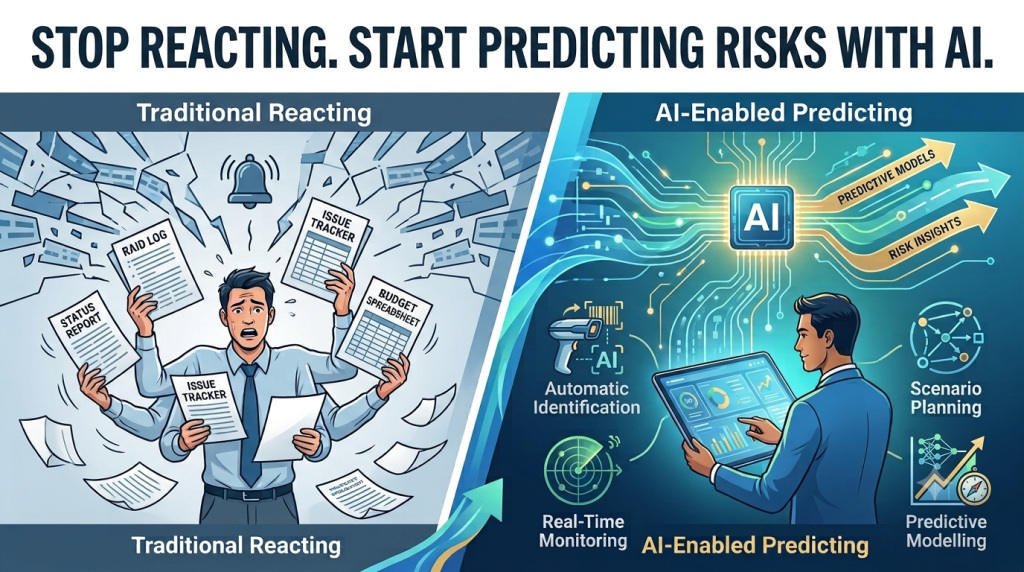
- Uncertainty and evolving risks
- Conflicting stakeholder priorities
- Continuous trade-offs rather than binary decisions
Expecting AI to “run programs” misunderstands the role. However, using AI to augment judgment is a different—and far more powerful—conversation.
Where AI Actually Helps Program Managers
Instead of starting with tools, it’s better to start with tasks to be done.
1 . Sense-Making
Programs generate enormous amounts of fragmented information — status updates, risk logs, meeting notes, emails, dashboards.
AI is particularly strong at:
- Collating and analysing from multiple multi-modal inputs.
- Identifying recurring themes and anomalies
- Highlighting weak signals that humans may miss
Leveraged well, AI becomes a sense-making assistant, not a reporting replacement.
2. Decision Support (Not Decision Making)
AI will not replace program decisions — but it can:
- Help articulate options and trade-offs
- Compare scenarios (“If X slips, what is impacted?”)
- Surface historical patterns from past programs
The final call still requires context, judgment, and accountability — things AI does not possess.
3. Communication and Alignment
One of the most time-consuming aspects of program management is communication across layers.
AI can help:
- Draft executive-ready summaries
- Translate detailed delivery data into outcome-focused narratives
- Maintain consistency across stakeholder communications
This frees up time for conversations that require presence and nuance.
4. Learning and Capability Building
Programs often span domains, technologies, and business contexts.
AI can accelerate:
- Onboarding into unfamiliar domains
- Just-in-time learning for new concepts
- Preparation for difficult conversations or reviews
This doesn’t replace experience — it compresses the learning curve.
What to Be Careful About
AI adoption in programs comes with real risks :
- False confidence from fluent but shallow outputs
AI-generated plans or risk logs may appear credible while missing critical assumptions, constraints, or context
. - Over-automation of judgment-heavy decisions
AI-driven prioritization or performance scoring can optimize metrics while overlooking strategic intent, stakeholder dynamics, and long-term impact. - Tool-first thinking that ignores systemic issues
Using AI to accelerate reports or dashboards may mask deeper problems such as unclear strategy, weak governance, or misaligned incentives. - Delegating accountability to algorithms
Make it explicit who owns decisions informed by AI and ensure transparency on how recommendations were generated.
A useful reminder:
AI can accelerate poor program management just as easily as good program management.
A Simple Starting Point for Program Managers
If you’re wondering where to begin:
- Pick one recurring pain point (status synthesis, risk review, dependency tracking)
- Use AI for drafting and sense-making, not final answers
- Apply your experience and context as the final filter
- Build a habit before building a tool stack
Tools do play a significant role and here is a good source.
Start small. Stay intentional.
Closing Thought
AI is most powerful in Program Management not because it does more — but because it allows leaders to do what matters.
In the Iceberg Model, the visible work of programs sits above the surface: plans, dashboards, and milestones. But the forces that determine success — judgment, trust, and sense-making under pressure — lie below.
AI strengthens the visible layers.
Leadership shapes the invisible ones.
That is why AI doesn’t replace Program Managers.
It amplifies those who are capable of leading beneath the surface.
Iceberg Model
Program Management can be visualized as an iceberg where a smaller part above the water is visible while the bigger part is hidden and is invisible. Plans, dashboards, milestones ae the visible parts whereas fostering collaboration and team empowerment (leading others), and strengthening personal presence, empathy, and resilience (leading self) are hidden..