



This main article details PM Power Consulting’s proprietary coaching framework, ENVISIONSM, developed from years of experience and best practices from established models. PM Power, founded in 2006, focuses on project management, execution excellence, and leadership development, offering consulting, training, and coaching services.
ENVISIONSM is a structured approach to coaching based on principles like coachee empowerment, mutual trust, and non-judgmental guidance.
The introduction details the background to ENVISIONSM.
Key components of the ENVISIONSM framework:
- Principles: Emphasize coachee empowerment, learning, collaboration, trust, ethical conduct, non-judgmental support, and a focus on the present/future.
- Techniques: Include active listening, visualization, powerful questioning, and fostering accountability.
- Strategies: Tailored to individual needs, encompassing skill gap resolution, strength-based coaching, vision-based coaching, overcoming limiting beliefs, potential-based coaching, growth mindset adoption, mindful approaches, support network building, and leveraging risk appetite.
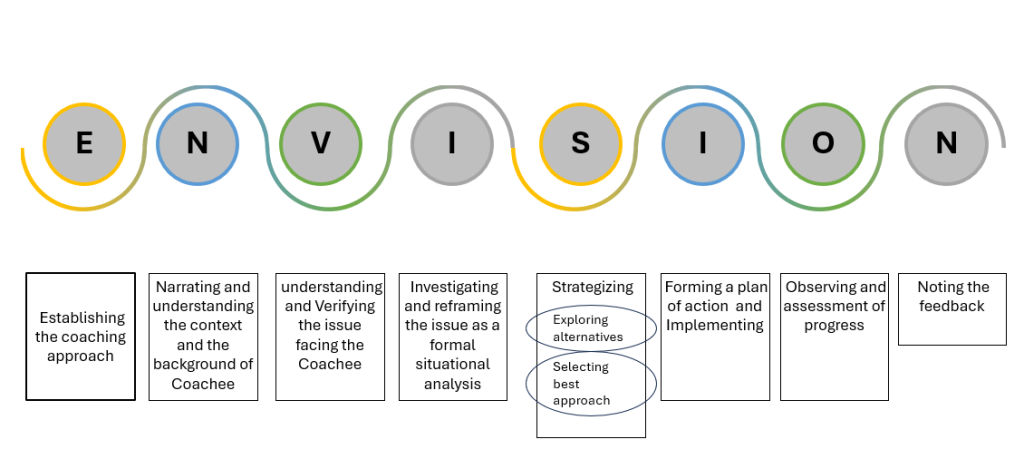
- Methodology (ENVISION Acronym): Establishing trust and agreement; Narrating and understanding the context; Verifying the issue; Investigating and creating a situational analysis; Strategizing (exploring alternatives and selecting the best approach); Implementing an action plan; Observing and assessing progress; Noting feedback.
In conclusion, PM Power has successfully applied ENVISIONSM in diverse scenarios, including cross-cultural, remote, and high-pressure coaching, achieving outcomes like role transition preparation, leadership development, and performance enhancement. The framework’s effectiveness is attributed to its structured methodology, adaptable strategies, and emphasis on coachee empowerment.
The article acknowledges the following people’s contributions: Mohanram, Milind, KP, JV, ShivK, Vasu, Anand, and Ramesh