

What Is the Likelihood of Success of Your Transformation program?

Abstract
Organizations launch transformation programs to achieve strategic goals, e.g Seeking Growth, Achieving Execution Excellence, Operating Model Shifts, Ways of Working shift, AI Centricity, Digital Enablement, or Leadership and Culture change, to name a few. These programs typically span 18-24 months and demand substantial leadership attention, investment, building capabilities and organizational energy. Yet many transformations fail to reach the intended Target State or Stated Outcomes – not because teams do not work hard, but because leaders lack a practical way to sense progress early, detect stall signals, and steer decisively before outcomes are locked in.
This paper introduces a practical framework to increase transformation success by treating success as a probabilistic outcome – a measurable Likelihood of Success (LoS) rather than a binary ‘on track/off track’ narrative. We propose LoS as a function of two dimensions: Transformation Marker Health (the enabling conditions and system capability required for progress) and Leading Indicator Momentum (movement signals that show whether the system is actually shifting toward the Target State). We further propose that transformation must be designed and governed as Pathways – orchestrated journeys from Current State to Target State – rather than a portfolio of disconnected initiatives, and that these pathways must be steered through a coherent lens: the 3-Engine Framework of Execution, Growth, and Human Engines.
The result is a leadership-ready approach to continuously answer the most important question in any transformation: How likely are we to succeed within the intended timeframe – and how do we adaptively steer along the way to improve that likelihood?
Contents
- Abstract
- 1. The Transformation Reality Check
- 2. The Missing Question in Transformation Governance
- 3. Transformation is a Pathway and Not a Set of Initiatives
- 4. A Transformation Navigator with Continuous Sensing and Active Steering
- 4.1 Likelihood of Success: A Practical Frame
- 4.2 Transformation Markers: Is the System Capable of Producing the Results?
- 4.3 Leading Indicators: Is Momentum Building – or Quietly Stalling?
- 4.4 Lagging Indicators and Distance to Target State: Confirming Outcomes, Not Steering
- 4.5 Active and Adaptive Steering
- 5. Designing Transformation Pathways
- 5.1 Orchestrating Pathways through the 3-Engine Framework
- Execution Engine
- Growth Engine
- Human Engine
- 6. A New Standard for Transformation Leadership
1. The Transformation Reality Check
Organizations embark on transformation programs for many reasons: to accelerate growth, improve execution reliability, transform to an AI-First company, modernize operating models, strengthen innovation capacity, build leadership and culture, or respond to shifts in technology and market expectations, to mention a few.
These programs are rarely short. Most enterprise transformations run 18-24 months, sometimes longer. They re-define organizational identities, re-shape structures, governance, processes, technology, capabilities, behaviors, and ways of working. They consume leadership bandwidth and organizational attention over an extended period.
Yet, despite strong intent, initial enthusiasm and investment, many transformations do not fully achieve the desired Target State. Some deliver at best partial benefits and worst stall halfway. Some declare success while core behaviors and system constraints remain unchanged.
The cost is not only financial. It includes change fatigue, leadership credibility loss, and reduced organizational belief in future transformation efforts.
2. The Missing Question in Transformation Governance
Most transformation governance focuses on familiar questions: Are initiatives on plan? Are milestones being met? Are risks tracked and mitigated? Are outcome metrics improving?
These are necessary, but not sufficient. They do not answer the question that matters most:
How likely are we to succeed – given where we are today?
This question is rarely asked explicitly. When it is asked, answers tend to be subjective (‘We feel on track’), optimistic (‘We will catch up next quarter’), or retrospective (‘We missed early signals’).
As a result, leadership course-corrects late. By the time lagging metrics confirm the problem, the transformation has already accumulated structural debt: misaligned incentives, overloaded governance, fragmented priorities, capability gaps, and organizational fatigue.
This is when transformation governance becomes a sequence of reviews, not an adaptively steered journey.
3. Transformation is a Pathway and Not a Set of Initiatives
A common failure mode is conceptual, not operational. Many organizations run transformations as a portfolio of initiatives: agile and operating model rollouts, platform and tooling programs, capability-building, process improvements or governance redesign.
Each initiative may be well-designed and competently executed. But collectively, the organization may still fail to reach the Target State. Why? Because transformation is not a sum of initiatives.
We propose that Transformation should be a Pathway – an orchestrated journey from Current State to Target State. A pathway makes explicit: dependencies and sequencing; trade-offs and choices; capability-building required before performance shifts; where leadership must intervene and where teams can self-drive; and which investments matter now versus later. Along these pathways, organizations go through interim states that are also irreversible. Without pathways, organizations can execute efficiently and still drift strategically.
4. A Transformation Navigator with Continuous Sensing and Active Steering
A transformation of even a small magnitude cannot be managed with static roadmaps and periodic scorecards. It needs continuous navigation – a way to sense progress, detect stall signals early, and steer in time.
This is what we propose – a Transformation Navigator. This is by no means a reporting dashboard. It is a leadership steering mechanism that helps answer repeatedly and objectively all along the journey: Are we still on a credible trajectory to reach our Target State within the intended timeframe? Are we building the conditions required for progress? Is momentum increasing or stalling? What must we adjust now – before results are locked in?
Most importantly, a Navigator reframes transformation success as a probabilistic outcome, not a binary judgment.
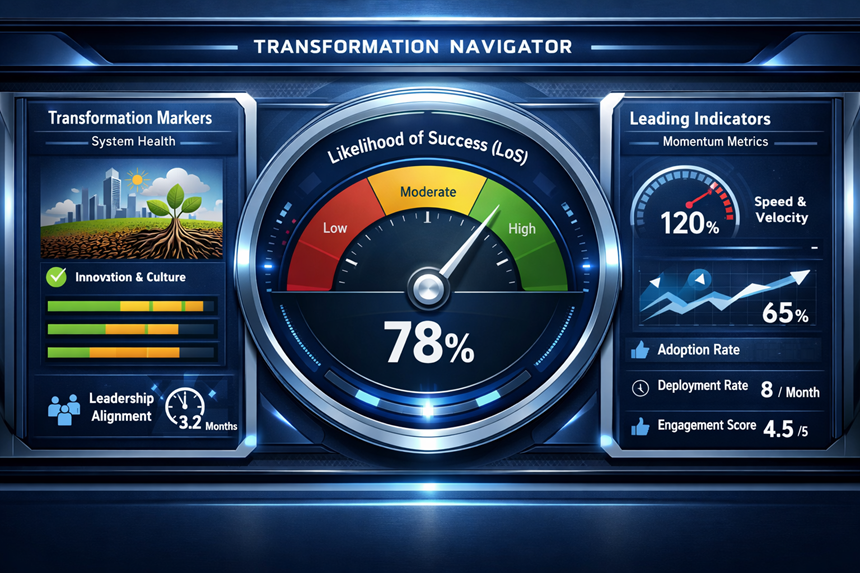
Image shown only for illustration purposes only
4.1 Likelihood of Success: A Practical Frame
At the core of the Navigator is a simple idea:
Likelihood of Success (LoS) = f (Transformation Marker Health x Leading Indicator Momentum)
This formulation reflects a leadership truth: momentum without enabling conditions is fragile; enabling conditions without momentum produce inertia; if either collapses, success becomes unlikely – regardless of effort.
LoS reframes transformation governance from status tracking to adaptive steering. It allows leaders to intervene where it matters most – early and as often, when course correction is still feasible.
4.2 Transformation Markers: Is the System Capable of Producing the Results?
Transformation Markers are the pre-conditions for progress. They are structural, behavioral, and systemic conditions that determine whether the organization is capable of producing the intended outcomes.
Markers are not performance metrics. They are system capability signals – observable and trackable over time.
Markers answer:
Is the system designed to succeed?
Examples of markers include: decision-rights clarity and effective governance; alignment between strategy and execution, operating model, and incentives; role-level capability expectations and enablement; data trust and availability at critical decision points; leadership alignment, energy, and sponsorship depth; psychological safety to surface issues and change behaviors.
Markers matter because they often determine whether leading indicators can move at all. When markers degrade, progress becomes performative: meetings increase, reporting improves, but the system’s ability to change weakens.
Markers are the soil in which leading indicators grow.
4.3 Leading Indicators: Is Momentum Building – or Quietly Stalling?
Leading indicators provide signals of movement toward the Target State. They reflect direction, speed, and adoption.
Leading indicators answer:
Are we moving the system in the right direction?
Examples include: adoption rates of new ways of working; improvements in cycle time, throughput, or predictability; decision turnaround time and decision quality signals; percentage of work flowing through the new operating model; early behavior shifts in leadership and cross-functional collaboration.
Leading indicators are valuable – but they have a built-in limitation: they often assume that enabling conditions are already in place. If marker health weakens, leading indicators plateau, reverse, or become cosmetically inflated. The earlier the stall is detected, the more options leadership has to respond.
4.4 Lagging Indicators and Distance to Target State: Confirming Outcomes
Lagging indicators confirm results: revenue and margin shifts; productivity improvements; time-to-market reduction; customer outcomes; engagement or retention trends.
They answer:
Did we get there?
Lagging indicators are essential for accountability, but they arrive too late to steer effectively. That is why a Navigator continuously maintains visibility of: distance from Current State to Target State; rate of movement (trend and slope, not point snapshots); and timeframe credibility (are we still likely to arrive on time?).
This creates a shared understanding of progress and risk – without relying on optimism or narrative.
4.5 Active and Adaptive Steering
The practical value of the Transformation Navigator is active and adaptive steering.
By continuously paying attention to Likelihood of Success, which integrates marker health (system readiness and capability), leading indicator momentum (direction and speed), and distance to Target State (trajectory and timeframe credibility), leadership can: detect stall signals before they become failures; intervene at true leverage points (not surface symptoms); re-sequence pathways and rebalance investments; enable sharper leadership conversations and decisions; reduce change fatigue by avoiding thrash and late reversals.
Transformation then becomes an actively steered journey, not a series of post-facto explanations.
5. Designing Transformation Pathways
Once Target State is clarified and LoS is measurable, leadership can design transformation as Pathways, not as a static roadmap.
Pathways represent: strategic choices and sequencing options; capability-building arcs; investment trade-offs across time; dependencies across functions, technologies, and behaviors; a realistic steering cadence (what must shift by when).
5.1 Orchestrating Pathways through the 3-Engine Framework
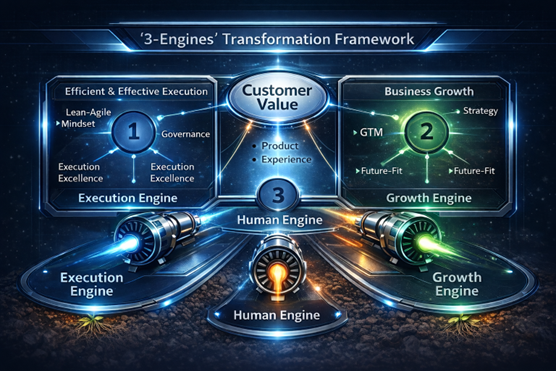
To govern pathways coherently, we use a PM Power 3-Engine Framework.
Execution Engine
Deliver today’s business reliably – quality, efficiency, predictability, delivery excellence.
Growth Engine
Build tomorrow’s business – innovation capability, strategic options, new revenue engines.
Human Engine
Enable leadership and culture – capability, alignment, energy, collaboration, and change capacity.
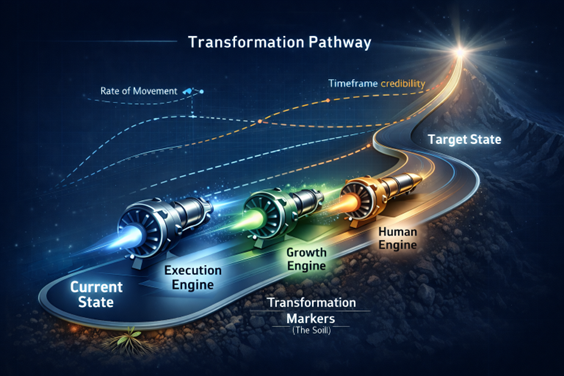
Transformation succeeds when execution, growth, and people systems move together, when these engines are optimized not in isolation. Sustainable results require orchestration – recognizing that emphasis shifts over time, but neglect is never free.
More than one pathway can be viable. The Navigator helps leaders compare pathways, understand constraints, and adapt as conditions evolve – without losing coherence.
6. A New Standard for Transformation Leadership
If transformation defines the future of the enterprise, leadership cannot afford to manage it blindly.
The question is no longer:
Are we executing?
It is:
How likely are we to succeed – and what must we change now to improve that likelihood?
Organizations that can answer this continuously will not only transform more successfully but will also build an enduring capability to change – again and again.
The Transformation Navigator improves success probability by making the invisible visible: it surfaces enabling conditions and constraints early; it clarifies whether progress is real or performative; it shifts governance from reporting to steering; it links system design, behavior change, and outcomes; it enables course correction while options still exist.
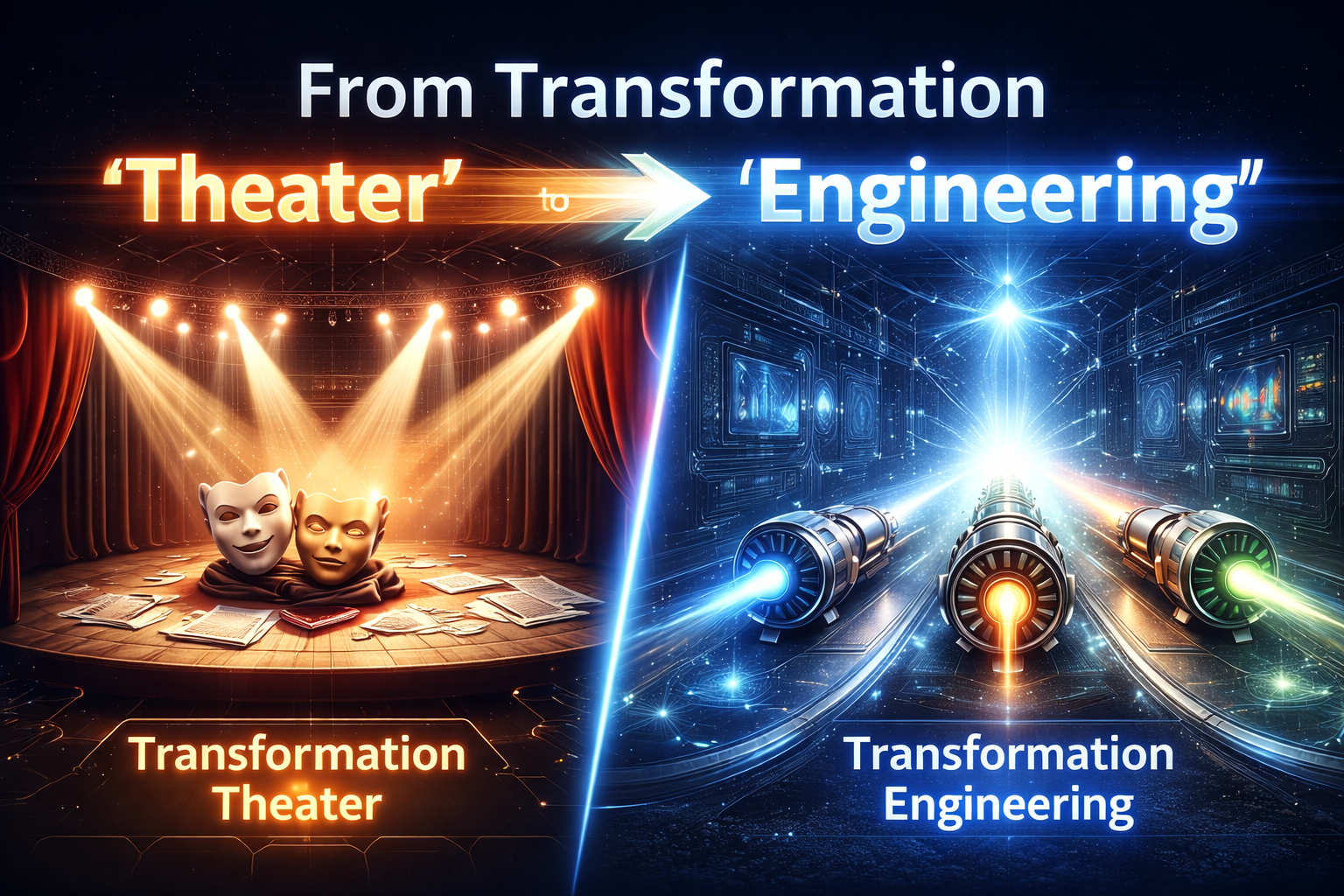
It replaces transformation theater with transformation engineering.
Talk to us if you are running a transformation program and you want to increase the LoS by deploying the Navigator!
About the author: https://www.pm-powerconsulting.com/experts/krishna-prasad/
More from the Author: https://www.pm-powerconsulting.com/full-stack-leadershipcast/