



Are you ethical?
Are you responsible?
Are you trustworthy?
What comes to mind when you hear these questions? Most of us immediately think about people—their character, values, or leadership qualities.
Today, AI is tightly integrated into our products, workplaces, financial systems, healthcare, and customer service. That means we must begin asking the same questions about the AI systems we design, deploy, and depend on.
If you work in AI governance, risk, compliance, technology, or product development, you’ve likely heard three terms repeatedly: Ethical AI, Responsible AI, and Trustworthy AI. They are often used interchangeably, but I’ve found a practical way to distinguish them:
- Ethical AI → Intent
- Responsible AI → Action
- Trustworthy AI → Evidence
Put simply:
- Ethical AI asks what values should guide us, and should we build this system at all?
- Responsible AI asks what practices and controls will make those values real?
- Trustworthy AI asks can we show proof that the system is reliable, accurate, and risk‑aware?
These aren’t universal definitions, but they provide a useful lens for understanding how values, operational controls, and evidence interact across the AI lifecycle. And importantly, these concepts overlap throughout the journey of building and running AI systems.
1. Ethical AI — Defining the Intent
Every powerful technology creates both opportunities and risks. AI can boost productivity, uncover hidden patterns, personalize services, and support critical decisions. Yet it can also introduce risks related to fairness, privacy, safety, security, autonomy, and fundamental rights.
This is where Ethical AI begins. It starts with a fundamental question: Should we build or deploy this system, and if so, what values should guide it?
Ethics is concerned with principles, values, human rights, and the broader impact of technology on people, organizations, and society. Several international initiatives provide reference points:
- OECD AI Principles (2019): Encourage innovative, trustworthy AI that respects human rights and democratic values.
- UNESCO Recommendation on AI Ethics (2021): Adopted by 193 member states, requiring AI to respect human dignity and rights, with principles such as transparency, fairness, sustainability, and human oversight.
- IEEE 7000-2021: Offers a structured process for embedding ethical values into system design and engineering.
Ethical AI helps organizations decide what should be implemented and what values must guide design and use. But identifying principles is only the beginning. Without practical mechanisms and accountability, ethics can remain a statement on paper—a situation often called ethics washing.
A company may publish an AI ethics statement like:
“We believe in fairness, transparency, privacy, and human oversight.”
But soon, practical questions arise:
- What happens if model performance declines after deployment?
- What if the system behaves differently across groups?
- Who is accountable when risks materialize?
Principles alone don’t create technical or organizational controls. They set direction, but they don’t guarantee responsible execution. That’s where Responsible AI comes in.
2. Responsible AI — Turning Intent into Action
If Ethical AI defines what we value, Responsible AI focuses on how we act on those values. It’s about embedding governance, engineering discipline, risk management, and accountability into every stage of the AI lifecycle. In practice, it transforms abstract principles—like fairness, transparency, privacy, inclusiveness, and safety—into concrete operational steps.
What does Responsible AI look like in practice? It can involve:
- AI Risk & Impact Assessments — Identifying affected stakeholders, conducting risk reviews, checking compliance with regulations such as the EU AI Act, and confirming that the solution is truly fit for purpose.
- Data Governance, Privacy, and Security — Establishing strict controls and role‑based access, verifying data sources, ensuring diversity to reduce bias, and securing information both at rest and in transit.
- Documentation — Maintaining clear records of models, systems, datasets, and training sources so decisions remain traceable and transparent for auditors and users.
- Testing and Red Teaming — Actively probing systems for weaknesses in safety, fairness, privacy, robustness, and misuse scenarios.
- Human Oversight — Keeping people at the center of critical decisions, with explicit workflows for review, approval, or override of AI outputs.
- Continuous Monitoring & Incident Response — Watching production systems for drift, unexpected behavior, or emerging risks, with logging and telemetry to investigate and refine models over time.
- Accountability — Defining ownership, deployment approval, incident response, and responsibility when things go wrong. Many organizations set up internal councils or committees to establish standards and guardrails.
This is where AI governance becomes more than a policy document—it becomes part of how teams actually build and operate systems.
The Execution Gap Ethical intent without Responsible AI practices remains only an intention. Responsible AI closes that gap by turning principles into consistent, repeatable actions. But that raises another question: How do we know those practices are effective? That leads us to Trustworthy AI.
3. Trustworthy AI — From Claims to Evidence
Trust must rest on objective, verifiable proof—not just organizational statements. A useful way to think about Trustworthy AI is: Can we demonstrate with evidence that the system works as intended, manages risks, and continues to meet safety requirements throughout its lifecycle?
Trustworthiness goes beyond technical accuracy:
- A system may be precise but vulnerable to security breaches.
- It may be safe but still produce biased outcomes across demographic groups.
- It may be explainable but unreliable under heavy use or novel conditions.
- It may perform well in testing but degrade in production.
This is why the NIST AI Risk Management Framework emphasizes the characteristics of trustworthy AI systems, including validity and reliability, safety, security and resilience, accountability and transparency, explainability and interpretability, privacy enhancement, and fairness with harmful bias managed.
How do you demonstrate trustworthiness? Evidence can include:
- Performance & Drift Monitoring — Regular checks to ensure accuracy and reliability over time.
- Security & Red Team Logs — Reports from stress tests and simulated attacks showing resilience against threats.
- Fairness & Bias Evaluations — Results confirming equal performance across demographic groups.
- Audit Trails & Documentation — Detailed records of data sources, model versions, approvals, risk checks, and incidents.
- Human Oversight Controls — Clear processes for experts to review or override AI decisions.
- Continuous Improvement Loops — Systematic fixes for reported problems and safeguards to prevent recurrence.
The goal isn’t to claim “our AI is trustworthy,” but to prove it with evidence.
4. Ethical vs Responsible vs Trustworthy AI
Below table is a simple way to connect these three terms.
While these three terms are often used interchangeably in casual discussions, classifying them down by values, operational controls, and verifiable evidence provides a clearer understanding of these AI governance themes.
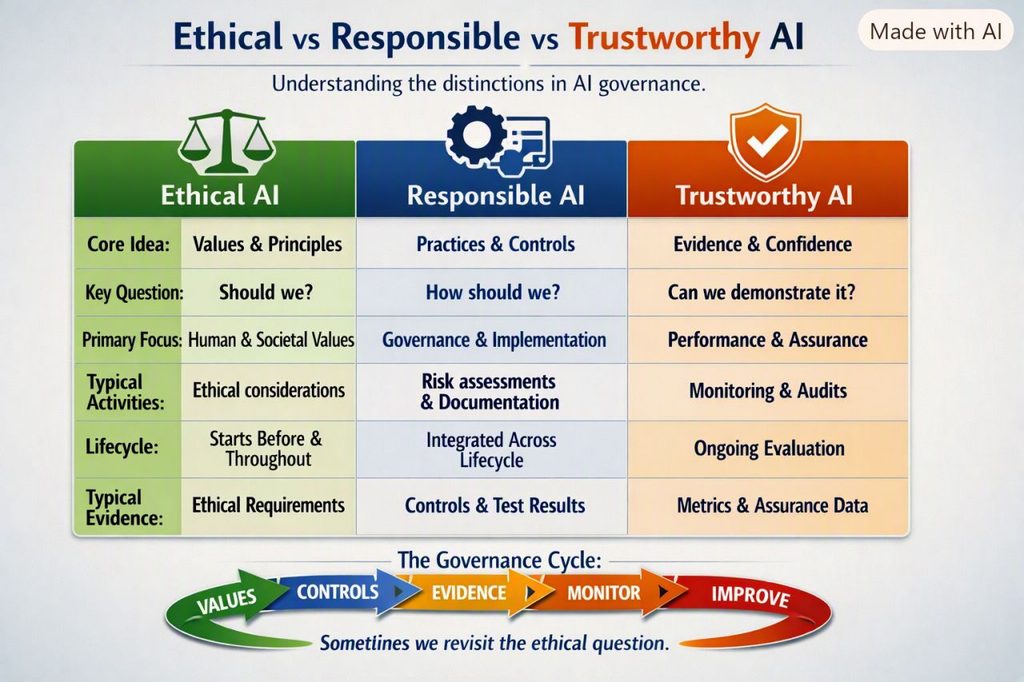
These are not three isolated boxes. They form a continuous governance cycle:
VALUES → CONTROLS → EVIDENCE → MONITOR → IMPROVE
And sometimes the evidence tells us that we need to revisit the original ethical question.
Summary
A simple way to remember the relationship is:
- Ethical AI → What should we value?
- Responsible AI → How do we act on it?
- Trustworthy AI → What evidence supports it?
The cycle continues: Values → Controls → Evidence → Monitor → Improve.
AI governance doesn’t stop once a system is deployed. Evidence from real‑world use can reveal new risks, requiring organizations to refine controls—and sometimes even rethink the original ethical assumptions.
So, where does your organization’s AI governance stand today: defining values, building controls, or producing evidence?