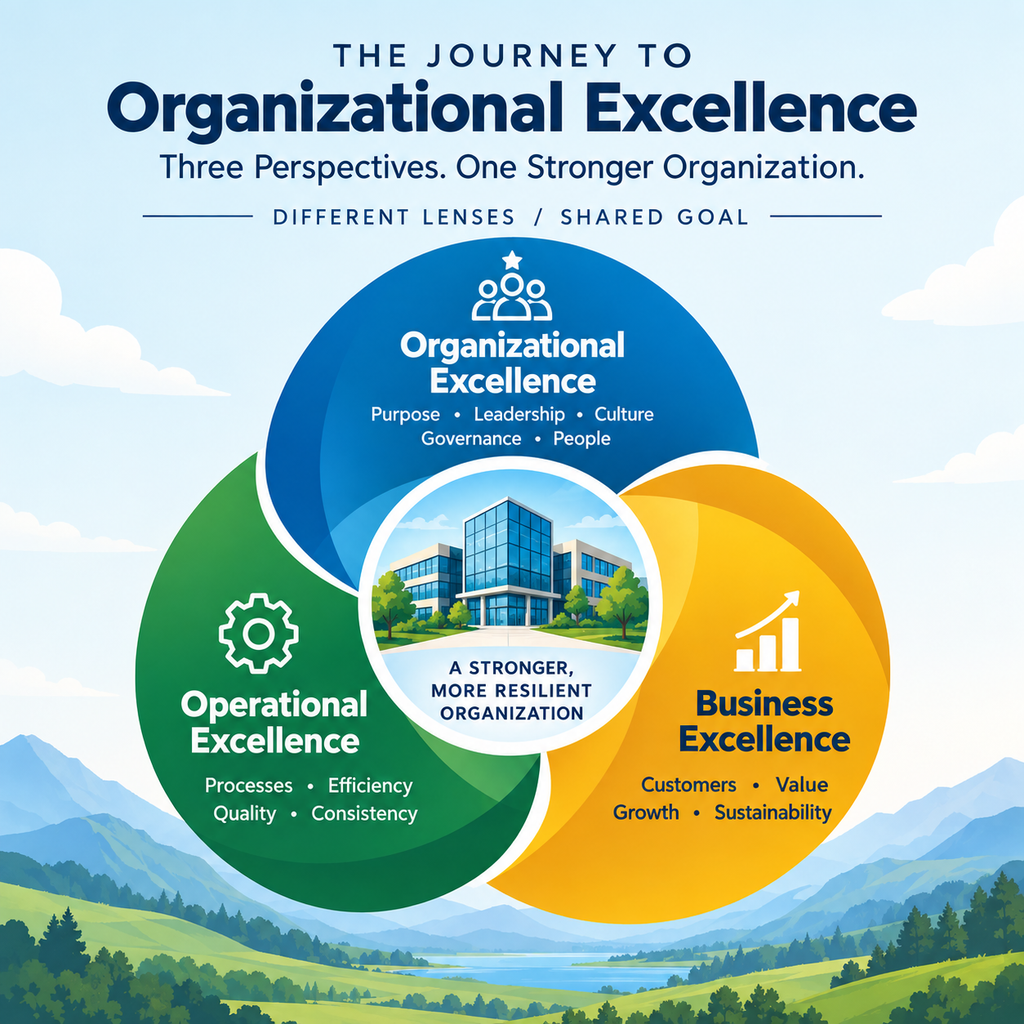



In our previous article, we distinguished between Operational, Organizational, and Business Excellence perspectives. To recap, Organizational Excellence focuses on purpose, leadership, culture, governance, and people; Operational Excellence emphasizes effective processes, efficiency, quality, and consistency; and Business Excellence focuses on customers, value creation, growth, and sustainability. Having excellent functions, processes, technology, or people individually does not automatically create an excellent organization. There is a need for alignment and integration across functions, so that the organization can continue to perform, learn, adapt, and continuously reinvent itself. This becomes increasingly important as AI changes not only processes, but also how people work, how decisions are made, and how organizations are structured.
Now the question, who should own Organizational Excellence?
At first glance the answer looks simple – perhaps HR, Strategy, Transformation, Operations, or even the CEO’s office. But is the answer, right?
And, how many organizations explicitly mention the word in published or disclosure documents? Very few if at all, making you wonder whether organizations actively pursue Organizational Excellence. But is that a fair conclusion that orgnanisations do not worry about Organizational Excellence? Let us explore
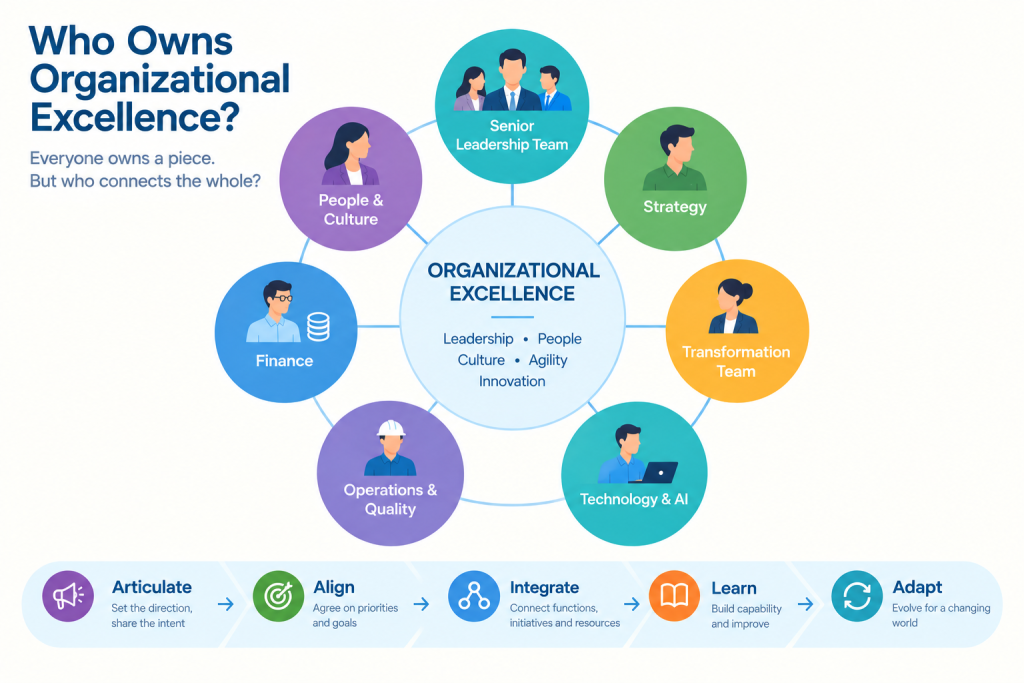
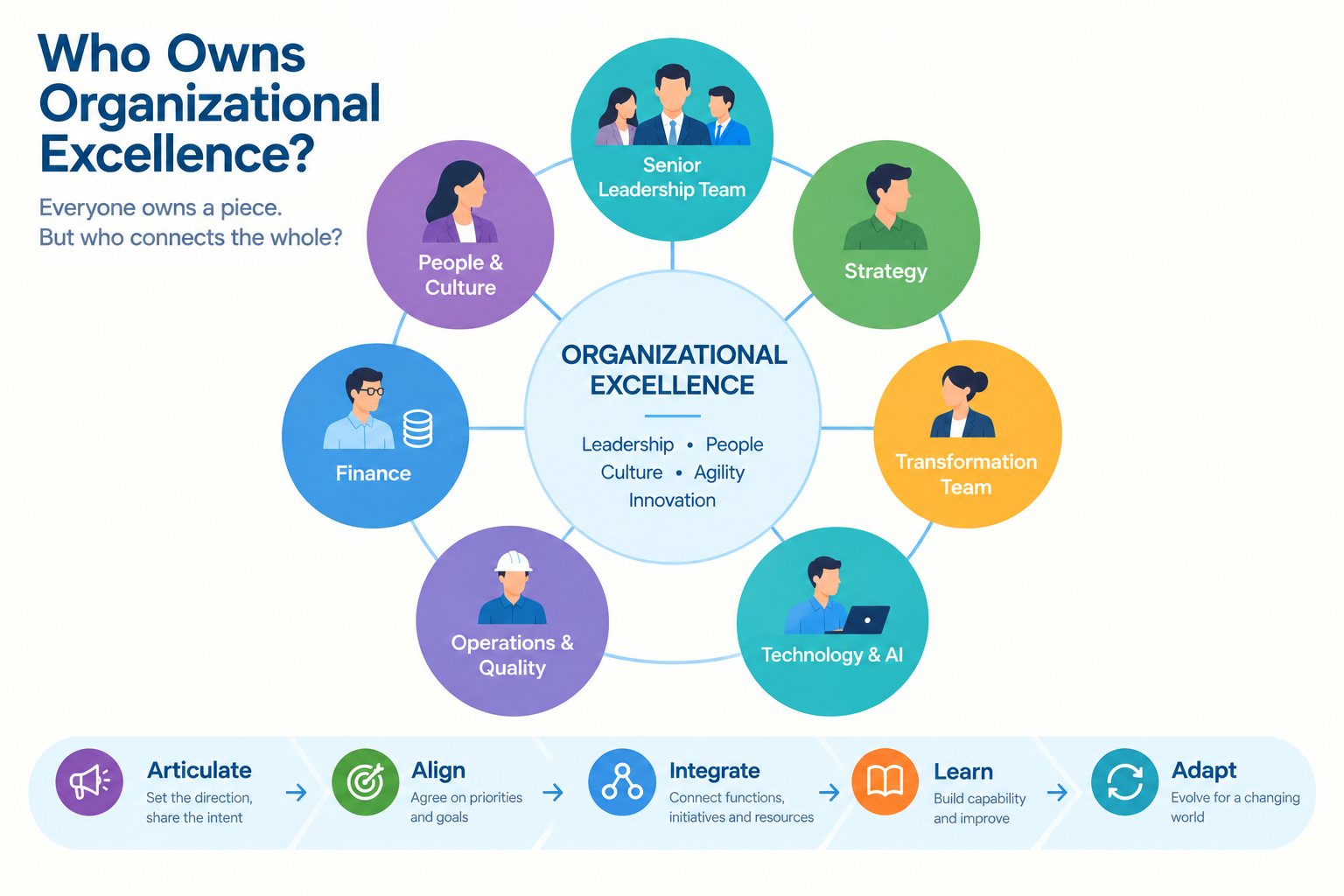
Everyone Owns a Piece — But Who Owns the Whole?
Actions resulting from the question -“How can we build an organization that is better at doing the work?” lead to Organizational Excellence. Focus here among others includes leadership, people, structure, culture, decision-making, Ability to adapt etc.
So, Organizational Excellence cannot be a single, isolated initiative. It cuts across the very capabilities mentioned above that make an organization effective — leadership, people, structure, culture, decision-making, collaboration, agility, learning, and innovation. Clearly none of these belongs to one function. It is, in effect, the combined capability and alignment of the entire operating system, not a line item that can be delegated easily.
Why Ownership Is Difficult
Look at the organization through the lens of any single function, and each has a genuine but only a partial claim to the territory:
| Function / Territory | What it naturally contributes to Organizational Excellence | Then why it does not fully own Organizational Excellence |
| HR | HR has a natural interest in people, leadership, and culture, and shapes the leadership pipelines that build a high-performance culture. | But Organizational Excellence is more than people practices — it also spans process, structure, and decision-making. |
| Strategy | Strategy looks at direction, priorities, and alignment across the enterprise facilitates enterprise-wide execution | But strategy alone does not create the organizational capability needed to execute and adapt once direction is set. |
| Transformation | Transformation focuses on changing the organization and delivering specific strategic initiatives. | But transformation is often programme-oriented and time-bound, and may not own the organization’s ongoing, everyday capability. |
| Business Leaders | Business leaders are ultimately accountable for performance and outcomes. | But their attention is understandably focused on immediate business priorities, and organizational capability often competes with delivery demands for their time. |
| Technology & Digital | Technology and Digital increasingly shape how organizations work, particularly with AI. Automates workflows and enables agility and real-time visibility. | But technology is an enabler; it cannot by itself determine the right structure, culture, leadership, or decision model. |
| Operations & Quality | Operations may have strong disciplines around performance and continuous improvement. Eliminates friction, optimizes processes, sets repeatable standards | But Organizational Excellence goes beyond the execution of work to the capability of the organization itself. |
| Finance | Finance brings discipline around performance management, resource allocation, financial governance, risk, and business sustainability. It provides an important enterprise-wide view of how resources are being used and whether the organization is creating value. | But Organizational Excellence is broader than financial performance and control. It also encompasses leadership, people and culture, organizational structure, ways of working, decision-making, innovation, and the organization’s ability to learn and adapt. |
The Danger of the “Excellence Silo”
Assigning sole ownership to one isolated department produces two systemic problems:
- Passive ownership — line managers assume continuous improvement is “someone else’s job.”
- Localized optimization — units hit their own metrics without improving end-to-end business performance.
Real excellence emerges at the intersections of functions, not within their boundaries — which is exactly why every core function contributes a distinct pillar to the whole.
This is precisely why treating excellence as a standalone department is a paradox rather than a solution: it lets every other function quietly assume continuous improvement is “someone else’s job,” while the isolated department has neither the authority nor the reach to fix problems that live at the intersections.
From Functional Ownership to Enterprise Ownership
Alignment
Organizational Excellence is ultimately an enterprise-level responsibility. The CEO and senior leadership team carry the greatest influence, since they shape direction, leadership expectations, structure, priorities, and the decision environment. In short, the Leadership articulates goals for the organization clearly and gets it cascaded to everyone. This makes the entire organization Aligned to the same goal and every member and team works towards achieving this goal. This avoids wasted effort and teams pulling in different directions. But leadership sponsorship creating Alignment alone is not enough.
Integration
What is also needed is a mechanism that connects the different dimensions of organizational capability: identifying gaps, preventing conflicting initiatives, establishing priorities, and measuring whether the organization is actually becoming more capable over time – in short Integration is needed. Integration refers to the coordination and collaboration mechanisms that align the separately-specialized functional groups toward common goals. Integration is the deliberate effort to counteract any fragmentation in collective working so the organization functions as a coherent whole rather than a collection of disconnected teams.
Moving to Enterprise Ownership for Organizational Excellence
Both Alignment and Integration are needed as prerequisites for Organizational Excellence and both need to go hand in hand. So how do we then go about creating Enterprise Ownership?
Clearly, we need to answer 3 questions when we embark on Organizational Excellence.
- Who sets the direction and helps alignment?
- What integrates the different dimensions?
- Who is accountable for the organization’s overall capability?
One organization may create a dedicated Organizational Excellence function. Another may place it within Strategy or Transformation. Another may make it part of HR’s organization-development mandate. Yet another may distribute the responsibility across the leadership team, with a central team providing coordination and measurement.
However, the CEO or the Senior Leadership needs to take the full accountability in all cases. The reason simply being, these are better equipped to get the end-to-end picture and take appropriate decision making,
PM Power Consulting’s FARM framework is an example methodology for achieving Alignment and Integration by facilitating CEOs and Senior Leadership to articulate their intent and goals, identify gaps, prioritize actions. This creates alignment across the organization, support the rollout of initiatives to integrate teams. Then monitor and evaluate outcomes to learn leading to Organizational Excellence that builds a future-ready organization.
The Takeaway
So, who owns Organizational Excellence? Direction and alignment come from the CEO and senior leadership, since they are the ones who set goals and get the organization pointed the same way. Integration across the different dimensions — people, structure, culture, decision-making — comes from a deliberate mechanism, whether that is a dedicated function, a placement within Strategy, Transformation, or HR, or a distributed model coordinated centrally, such as through a framework like FARM. But accountability for the organization’s overall capability rests, in all cases, with the CEO or senior leadership, since they alone hold the end-to-end view needed to make the necessary trade-offs.
In short, while every function contributes a piece of Organizational Excellence, it cannot be owned by any one of them in isolation — it must be driven, and ultimately answered for, from the top.
Let us get into more details on the various aspects of Organizational Excellence and how AI is helping to re-define the ways of working in subsequent articles.