
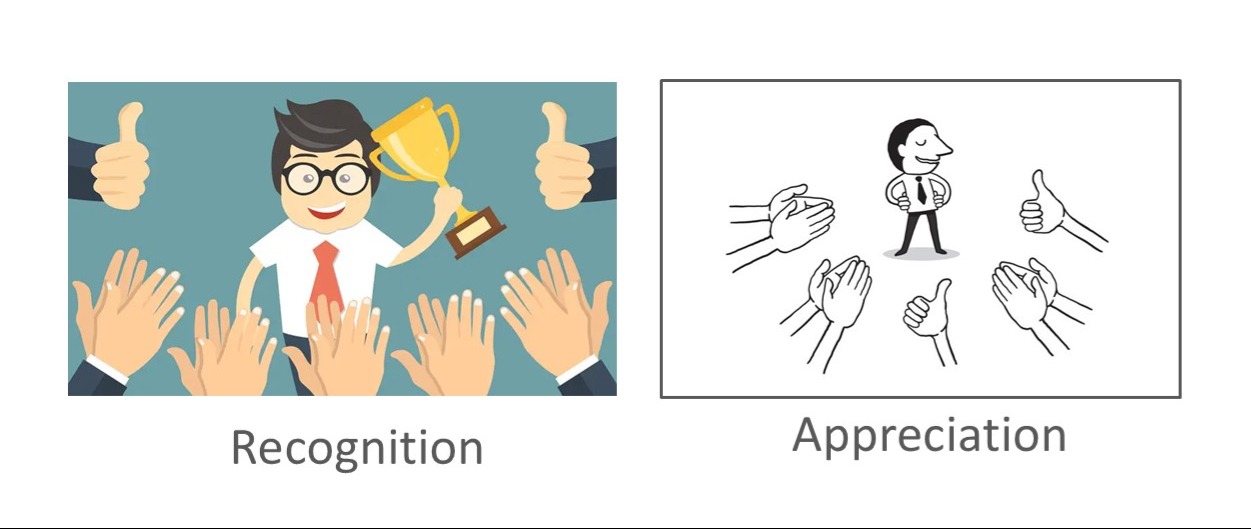
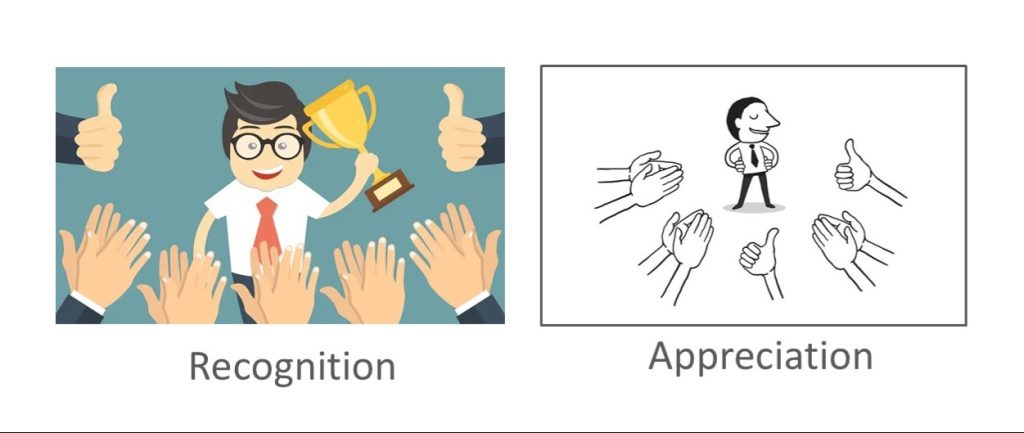
Normally people don’t distinguish between Recognition and Appreciation.
Recognition is about what you have done – done some good job, achieved some good result, and so on.; Appreciation is about who you are, what you are, your attitude and behavior etc.
Recognition is for DOING; Appreciation is for BEING.
Recognition comes from Head and reaches Head; Appreciation comes from Heart and touches Heart.
Appreciation is more powerful than just recognition in creating motivation in people, in employee engagement & satisfaction, in belongingness & retention and in improving their contribution. And it’s free.
Recognition is typically more formal and one may look for some significant accomplishment. Appreciation can be informal and can be at day to day working level.
Appreciating good behavior and attitude in public can help to build a positive culture and mindset in the organization.
When people are putting a lot of effort, but it’s not yielding desired results due to many external factors, Recognition may become sparse (as there are less opportunities to recognize); Whereas Appreciation does not have to wait for some accomplishment.
Sometimes Leaders have misconception, limiting belief or past conditioning that if I appreciate people more, they will become complacent, more demanding, arrogant, it will lose value etc. Appreciation surplus is always better than Appreciation deficit. Humans (and even animals) have appreciation hunger.
When asked during a Stanford Business School Interview about ‘how does Google sustain Innovation at that scale & for so long?’, Sunder Pichai said ‘we appreciate & reward people for their effort, not for result’ https://www.gsb.stanford.edu/insights/sundar-pichai-reward-effort-not-outcomes This is actually profound. It comes from Bhagavad Gita’s ‘Karmanyevaadhikarasthe Ma Phaleshu Kadachana” – Focus on the Action without attachment to the Fruits of the Action.
Appreciation Culture in an organization is a great Multiplier – it brings best out of people.
Appreciation Culture works top down – Leaders need to lead by example.
So, don’t be stingy on Appreciations, but let it be genuine & authentic!
9 Responses
An interesting “angle”! There is usually an emphasis on empathy among team members for better team work and self-organization. Would teams truly consider the manager/leader also as part of the team? Needs some mindset change. I think Emotional Intelligence training/coaching should bring out this aspect – that EI (Empathy being part of it) does not draw boundaries of applicability! Enjoyed reading a refreshingly different blog…
Thanks, Shiv. Yes, completely agree with your point on EI’s role in this regard. Gopal
Nice angle! And nice twist in the title of the blog!
Good perspective, which is normally missed.
🙏
Nice article, Gopal.
We all know one filed where downwards empathy is hardly ever seen, but upward empathy is expected and demanded. Politics.
😁
Nice article, Gopal! Very good insight. Practicing Empathy needs an effort as it needs seeing the world from the perspective of the another person. It is all the more difficult when you do not see everything that the other person sees. I remember one instance in my life when a manager reporting to me was promoted to senior manager’s post and moved away from me on a new, higher level assignment. After a few days she came to meet me and I enquired how she was doing on the new role. She said, “Milind now I know the kind of pressure you faced from above. You never passed that onto us and kept us shielded. Now I know how difficult your role and life is. I am trying to be like you!” So, the true empathy comes out of having experienced similar situations yourself.
So, Milind is the message “a little empathy is better than a late empathy”?
Gopal,
Nice blog.
This is a very valid and necessary perspective that everyone should have.
Somehow, in most organizations, just like ‘agile’ is considered as something for the teams and team members, these may be labeled as management and only for managers – as part of the leadership development plans.
Some ways how I have contextualized this in some situations:
• At an individual contributor level: connecting to empathy as a key skill for design thinking [observing and understanding users]
• At a team level: the togetherness and one-team idea [teams making commitments, the huddles in cricket and other sports etc], to use daily standups, for example, to recalibrate oneself after sensing how the others feel on that day or in a particular situation
• For managers: understanding and doing what they can, to make their managers successful, particularly when the complaint is that my manager does not understand me or my needs