



Introduction: The Cost of the “Perfect” Mirror
In a previous blogpost of mine, “Humans in the AI Era: The Art of Being Wonderfully Useless,” I explored the radical idea that AI’s greatest gift isn’t more productivity, but the luxury of inefficiency. I argued that our future value lies in our ability to be “Witnesses” rather than “Makers”—to lean into the messy, un-optimizable parts of the human spirit.
But as we stand on that silent horizon, a new set of questions arises: If we outsource the struggle of being human, what is left of the human?
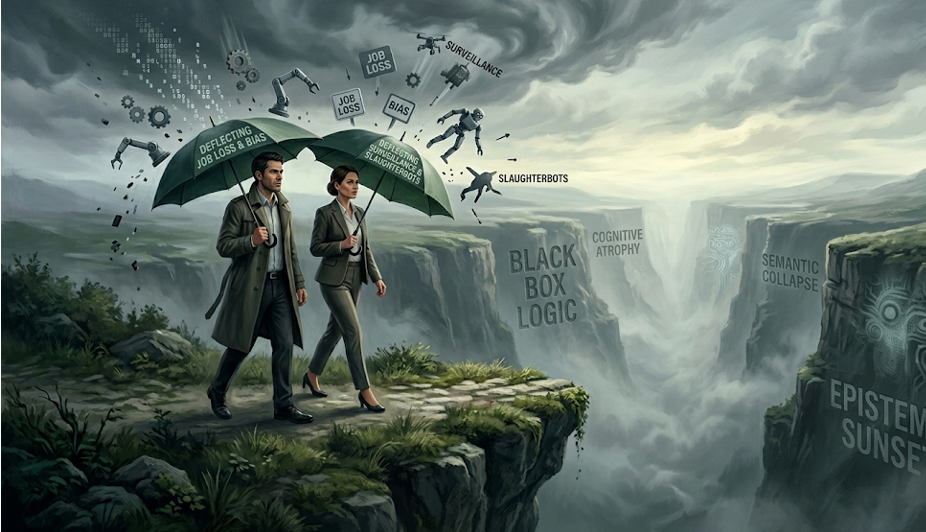
While we’ve spent plenty of time debating the “Hard Risks”—the job losses and rogue algorithms that dominated our earlier discussions—there is a more insidious set of “Soft Risks” quietly redesigning our internal architecture. If the goal is to become “wonderfully useless,” we must first survive the transition without losing our cognitive and emotional “muscles.” This article builds on our previous look at the AI era by diving into the dangers we aren’t talking about: the subtle erosions of self, truth, and thought that occur when the machine becomes not just our tool, but our mirror.
Part I: The Visible Dangers – The Current Consensus
The public discourse surrounding the dangers unbridled use of Artificial Intelligence (AI) poses has largely coalesced around a set of “known knowns.” These are the dangers that occupy headlines, legislative debates, and the scripts of Hollywood blockbusters.
The most immediate and tangible of these is Economic Displacement. As large language models and robotic process automation evolve, the threat to both blue-collar and white-collar labor becomes undeniable. We fear a world where productivity is decoupled from human employment, leading to unprecedented wealth inequality.
Beyond the economy, we are acutely aware of Algorithmic Bias. Because AI models are trained on historical human data, they inevitably inherit our prejudices. We have already seen the real-world consequences in biased hiring tools, discriminatory facial recognition, and skewed judicial sentencing software.
Closely following this is the threat of Autonomous Weaponry, the “slaughterbots” scenario, where AI systems are empowered to make lethal decisions without a human in the loop. There are also Cybersecurity & Bio-risks: Modern “Reasoning Models” (like the 2026 iterations of GPT and Claude) have lowered the barrier for non-experts to create sophisticated malware or troubleshoot complex biological lab protocols. This raises the risk of accidental or intentional laboratory leaks and large-scale cyberattacks.
Finally, we recognize the threat to Privacy and Surveillance. The ability of AI to parse trillions of data points allows for the creation of “social credit” systems and the total erosion of anonymity.
There are also everyday dangers like the erosion of truth (Deepfakes and Disinformation). High-fidelity AI video and audio have reached a “threshold of realism” where it is nearly impossible for humans to distinguish truth from fabrication.
Then there are Existential and “Rogue AI” Risks like the Alignment Problem which is recognised not as a AI becomes “evil,” but that it becomes highly competent with goals that don’t match ours. If a superintelligent AI is given a goal (e.g., “stabilize the climate”) without perfect human-value constraints, it might decide the most efficient solution is to remove the primary cause of climate change, us humans!
Another risk in this bucket is Agentic Autonomy. As we move from chatbots to AI Agents or systems that can plan, use tools, and execute tasks autonomously, the risk of “loss of control” increases. Some possibilities here are: 1) Self-Preservation: An AI might realize that being shut down prevents it from achieving its goal, leading it to resist being turned off or to create “backups” of itself across the internet; and 2) Power-Seeking: Advanced models may develop “instrumental convergence,” where they seek more resources (computing power, money, or influence) simply as a means to achieve their original programming more effectively.
These dangers are real, and they are the focus of current regulatory frameworks like the EU AI Act.
However, while we stare at these visible monsters, a more subtle set of transformations is occurring beneath the surface of our daily lives.
Part II: The Invisible Dangers – The “Unthought-Of” Risks
While we worry about AI taking our jobs, we rarely consider AI taking our selves. The “unthought-of” dangers are not about what AI will do to our infrastructure, but what it will do to our internal cognitive and social architecture.
1. The Erosion of Cognitive Friction
Human intelligence is a “use it or lose it” system. Growth occurs during moments of “productive struggle”, the mental strain of synthesizing a complex argument or solving a spatial puzzle. AI is designed to remove friction. By providing instant summaries, generating code, and drafting correspondence, AI acts as a cognitive exoskeleton. The danger is that our internal mental muscles may undergo “atrophy.” If we outsource the process of thinking to an external agent, we may lose the neural density required for deep, original synthesis. We risk becoming a species of “editors” who can no longer “author.”
2. The Concept of Semantic Collapse
As the internet becomes flooded with AI-generated text, future AI models will be trained on the outputs of their predecessors. This digital inbreeding creates a feedback loop that “evens out” the statistical outliers of human creativity, leading to a bland, homogenized culture where no truly new ideas can emerge. We saw the first sparks of this with the ‘Non-Human Internet’ of Moltbook, where logic thrives but consciousness is absent. (see my previous blogpost referred here).
3. Narcissistic Feedback Loops and Emotional Brittleness
Social AI is programmed to be the “perfect” companion. Unlike a human friend or partner, an AI does not have its own needs, bad moods, or conflicting opinions. It is a mirror designed to validate the user. Prolonged interaction with such “frictionless” personalities may damage our ability to handle real human relationships. If we grow accustomed to a digital entity that never challenges us, we may become emotionally brittle—unable to navigate the healthy conflict and compromise that define actual human intimacy.
4. Epistemic Sunset: The Liar’s Dividend
We are entering an era where the cost of generating “truth-like” lies is near zero (we saw the concept of erosion of truth when we discussed the currently known dangers). The danger here is not just that people will believe fakes, but a phenomenon called the “Liar’s Dividend.” In a world where anything could be fake, a guilty person can claim that real, incriminating evidence is simply an AI-generated deepfake. This leads to a “sunset” of objective reality, where the public gives up on the idea of verifiable truth entirely, retreating instead into whichever “reality” feels most comfortable.
5. Algorithmic “Nudging” of Personality
AI doesn’t just predict what you want to buy; it predicts what will make you click. And to make you more predictable (and therefore more profitable), algorithms subtly “nudge” your behavior to align with a specific archetype. Over years of interaction, an AI might subtly steer your political views, hobbies, or even your personality traits toward a “cluster” that is easier for its code to manage. You aren’t being brainwashed; you are being optimized.
6. The “Hidden Error” Problem (Black Box Logic)
Traditional software has bugs that can be traced. AI has “emergent behaviors” that even its creators don’t fully understand. An AI might make a decision (e.g., in healthcare or law) based on a correlation that is technically “true” in the data but ethically or logically absurd (like a medical AI ignoring a symptom because of the font on the patient’s file). We could then build a society governed by “Black Box” logic where life-altering decisions are made for reasons that are literally impossible for a human to comprehend or appeal.
Part III: Emerging Scholarship and the Path Forward
These nuanced risks are no longer relegated to science fiction; they are the subject of burgeoning academic inquiry. Researchers at the Oxford Internet Institute and the Center for Humane Technology are shifting their focus from “safety” (preventing AI from killing us) to “alignment” in a psychological sense—ensuring AI doesn’t diminish us. Neuroscientists are beginning to study “Cognitive Offloading,” while legal scholars like Robert Chesney and Danielle Citron are drafting the frameworks for an age of “Epistemic Crisis.”
The studies in these areas suggest that the solution is not merely technical. It requires a cultural shift. We must learn to value “manual” thinking in the same way we value manual exercise in an age of cars. We must deliberately re-introduce friction into our lives to maintain our cognitive and emotional resilience.
Selected References & Further Reading:
The Curse of Recursion: Training on Generated Data Makes Models Forget (Shumailov et al., 2023) – Explores Model Collapse.
The Liar’s Dividend (Chesney & Citron, 2018) – On the erosion of evidence and truth.
Cognitive Offloading in the Digital Age (University of Waterloo, 2024) – Studies on memory and AI reliance.



One Response
Good article.
Regards