



I was part of a program review with a PMO head of a large software organization responsible for managing multiple programs, all running concurrently. Program managers of respective program were also invited to the review meeting.
On paper, everything looked in order. Detailed plans. Established governance rhythms. Regular reporting in place.
But as the conversation unfolded, a different reality surfaced.
Several programs were clearly under strain. Milestones at risk. Outcomes uncertain. Not in a dramatic, visible way — but enough to suggest that things were quietly drifting off track.
So, I asked a simple question: What’s going wrong?
The responses were immediate — and familiar.
Scope changes. External dependencies. Resource constraints due to attrition.
All valid. All reasonable. But something didn’t sit right.
These felt less like root causes and more like familiar placeholders — the answers that surface when the real answer is still out of reach. And they surfaced late, when course correction had already become difficult.
What stood out even more was the absence of clarity beneath these answers. The program managers could sense the drift. They could point to pressure points. But they struggled to articulate the underlying cause.
That’s when I decided to go deeper.
What I expected to find was a breakdown in planning discipline or execution rigour.
What I found instead was something far less obvious — and far more consequential.
| It wasn’t the process that was failing. It was how decisions were made around it. |
The Pattern Behind the Symptoms
That experience is not unusual. Across organizations, when complex programs begin to struggle, the diagnosis tends to follow a predictable pattern: scope creep, dependency failures, resource constraints, skill gaps.
These are real challenges. But they are rarely the root cause. They are the conditions under which deeper issues become visible.
Programs do not fail simply because scope changes or dependencies exist — these are constants in any complex environment. What determines success is how leaders respond to them: how priorities are set, how trade-offs are made, and how consistently teams align around those decisions. When those elements are weak or inconsistent, the symptoms begin to surface. And no amount of process sophistication changes that.
Research consistently shows that more than 70% of large transformation programs either miss their original timelines, exceed their budgets, or fail to deliver the expected value — often all three. This is not a new problem. But it is a persistently misdiagnosed one.
The Rise — and Limits — of the “Science”
Over the past decade, organizations have significantly strengthened the science of program management. Planning frameworks are more robust. Tracking mechanisms more sophisticated. Risks and dependencies meticulously documented. Forecasting models are increasingly data-driven.
On the surface, this represents real progress. Organizations now have program management offices, standardised methodologies, state of the art tools, and reporting cadences that are considered best-in-class.
| If the science is stronger than ever, why do the same issues persist? Because process, by design, can only go so far. |
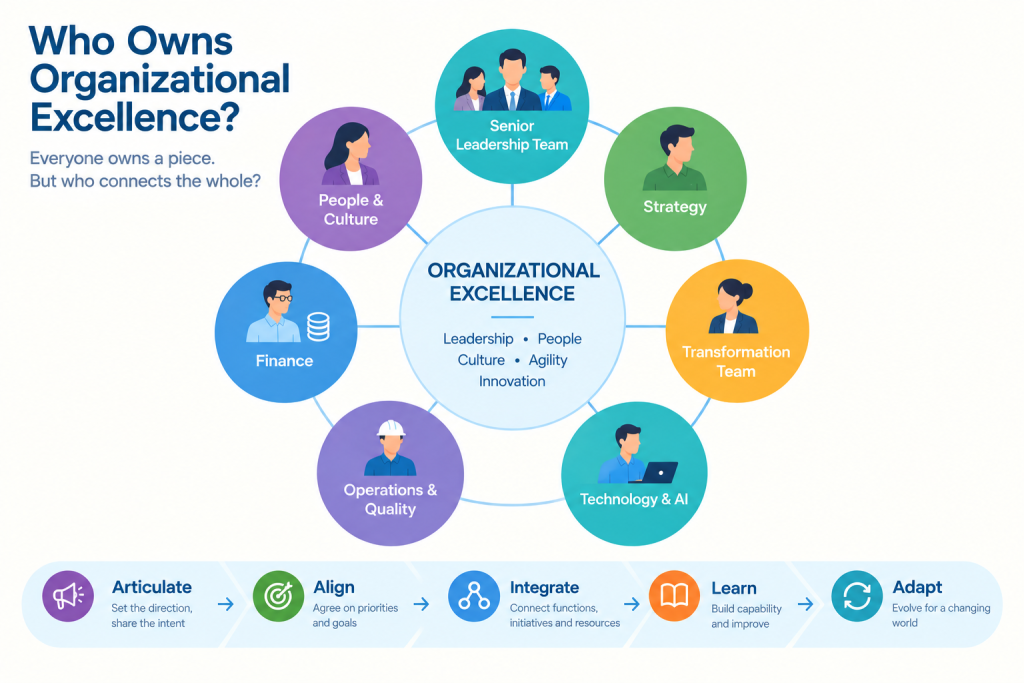
Process creates structure. It enables visibility. It supports coordination. But it does not, by itself, ensure alignment. And alignment — the quiet agreement among leaders about what matters most, what to trade off, and who decides — is what determines whether a program actually lands.
When Structure Masks Misalignment
In many programs, process gradually begins to fill gaps that leadership should address.
Detailed plans start compensating for unclear priorities. Governance forums begin to stand in for decision-making. Metrics become substitutes for meaningful conversations.
Everything appears structured. But structure can be deeply misleading.
Beneath it, small misalignments begin to accumulate. A decision deferred here. A dependency assumed rather than confirmed there. A risk acknowledged but not acted upon. Individually, these seem manageable. Collectively, they create drift.
Misdiagnosis — and Why It Is Getting Worse
When programs show signs of stress, the response is almost always logical and well-intentioned.
-
- Strengthen governance
-
- Introduce a new framework
-
- Deploy better reporting tools
-
- Increase reporting frequency
-
- Bring in additional program management resources.
Each of these actions addresses a perceived gap in discipline. Each is defensible. And each, in isolation, can genuinely help. But they rarely change outcomes in a meaningful or sustained way — because they operate on the assumption that the problem lies in execution mechanics, when the real issue lies one level up: in how decisions are being made, how ownership is defined, and how consistently leaders act in alignment with program goals.
| REAL-WORLD EXAMPLE | A global logistics company ran a supply chain transformation across six countries. Every status report showed green or amber. Every governance forum produced action logs. Eighteen months in, the program was quietly twelve weeks behind its critical milestones. When the warning signs emerged, the organization responded decisively — investing in a new program management platform, introducing real-time dashboards, automated risk registers, and AI-assisted forecasting. Within six months, reporting quality had measurably improved. But delivery outcomes barely shifted. The data was cleaner. The decisions were not. Every difficult call was still being escalated, deferred, or buried in a sub-workstream. The structure was intact. The tooling was upgraded. The alignment was not. Leaders were better informed about problems they still could not agree on how to solve — because the real issue had never been visibility. It had always been ownership. |
| Process does not fail due to lack of design. It fails when the leadership system around it is fragmented. |
This pattern of misdiagnosis is not new — but it is significantly amplified in today’s environment, which researchers describe as BANI: Brittle, Anxious, Nonlinear, and Incomprehensible. In such an environment, the traditional assumptions underpinning program planning break down. Small disruptions trigger disproportionate impact. Leaders under constant pressure make reactive decisions whose cumulative cost remains invisible until it is too late. Cause and effect become harder to trace. And more data does not create more clarity — in many cases, it creates more noise.
The Illusion of the Technological Fix
AI promises better forecasting, smarter risk identification, and faster reporting. These are genuine capabilities, and they are improving rapidly.
But AI operates within the same boundaries as the process it supports. It can surface patterns that humans miss. It can flag risks earlier. It can dramatically reduce the time spent assembling status reports.
What it cannot do is resolve ambiguity, align stakeholders, or make the difficult trade-offs that define whether a program succeeds.
| A USEFUL ANALOGY | Think of AI in program management like GPS navigation in traffic. It gives you the best available route based on current conditions. It recalculates when circumstances change. It tells you, with precision, how late you will be. What it cannot do is decide whether to take the meeting in person or join remotely, whether to change your destination, or whether the journey is worth making at all. Those are leadership decisions — and no amount of navigational precision changes that. |
Organizations that deploy AI tools without addressing the underlying alignment challenges often find that they have made an uncomfortable trade: they now have faster, more accurate visibility into programs that are still drifting. The information arrives more quickly. The decisions do not.
Used well — as a complement to strong leadership rather than a substitute for it — AI can be genuinely transformative. The organizations getting the most from it are those who used it to free up leadership time and attention, not to replace leadership judgement.
Understanding the root cause of the Failure
Most organizations today are not lacking in capability. They have frameworks, tools, and talent. The gap lies in how leadership applies them under pressure.
Complex program failure is rarely a failure of design. The plans are usually good. The frameworks are usually sound. The people are usually capable.
It is a failure of alignment, ownership, and leadership consistency — and these are things that no framework, tool, or reporting upgrade can substitute for.
For CXOs, this reframing has a practical consequence. The question when a program starts to drift is not: do we have the right process? It is:
-
- Are the right decisions being made by the right people, at the right time?
-
- Is ownership of the hardest calls clearly named — not shared, not assumed, but explicitly assigned?
-
- Are our leaders aligned on what success actually looks like — and what they are willing to trade off to get there?
-
- Do we have a clear protocol for how we make decisions when circumstances change in ways we did not plan for?
In complex, fast-moving environments, stability comes from: clear ownership, clear priorities, and a shared protocol for how decisions get made when circumstances change in ways the plan did not anticipate.
Closing Thought
The next time a complex program begins to drift — and at some point, it will — resist to reflex at the predictable pattern: scope creep, external dependencies, resource constraints, skill gaps etc.
Instead, ask the question that is harder to ask and harder to answer:
Are the right decisions being made — by the right people — at the right time?
For CXOs and senior leaders, this is worth sitting with. When you look at your portfolio of complex programs, ask yourself honestly: do your governance forums produce decisions, or do they produce meeting notes? Is accountability for the hardest calls clearly named — or quietly shared, which is another way of saying owned by no one?
In Part 2 of this series, we will explore the ‘art’ of program management — what it takes to lead effectively in complex, high-pressure environments, and the practical habits that distinguish the program leaders who consistently deliver from those who consistently explain.