
Seven pillars of Servant Leadership

Often I get asked by Scrum Masters, who are in the process of adopting Agile Scrum, on references to servant leadership. How should one go about changing from “command and control style” to “servant leadership”.

I used to share relevant examples from my experiences that has helped teams self-organize. Highlight instances, based on my observations of the Scrum Master at work, that were good examples of Servant Leadership and also point out instances of Command and Control behavior.

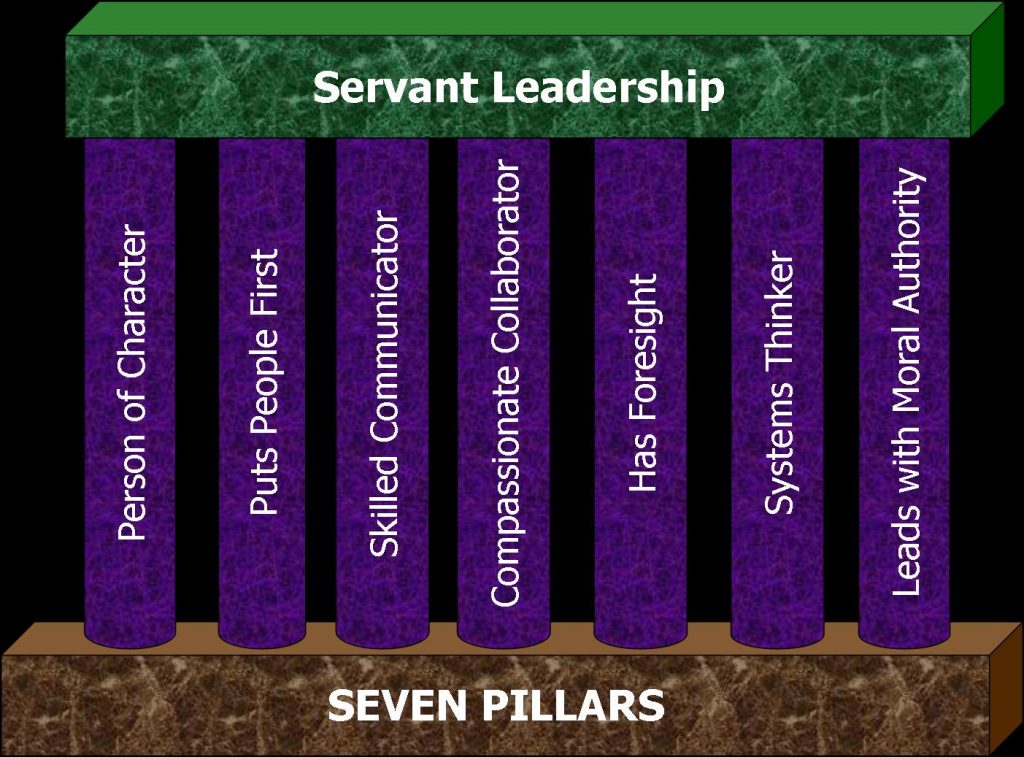
I came across the Seven Pillars of Servant Leadership, that captures this quite comprehensively. This idea was first mooted by Robert Greenleaf and further worked upon by James Sipe and Don Frick. This is a good reference that I share with the Scrum Masters and also their managers.

I am sure that you will be able to relate to these and find them relevant and applicable.
SevenPillars ofSevantLeadership


1. Person of character:

  • Makes ethical and principle-centered decisions
  • Maintains integrity
  • Demonstrates humility
  • Serves higher purpose

2. Puts people first:

  • Shows care and concern
  • Helps others meet their goals
  • Helps others grow

3. Skilled communicator:

  • Listens earnestly & speaks effectively
  • Demonstrates empathy
  • Invites feedback
  • Communicates persuasively

4. Compassionate collaborator:

  • Strengthens relationships, supports diversity and creates a sense of belonging
  • Expresses appreciation
  • Negotiates conflict

5. Has foresight:

  • Imagines possibilities, anticipates the future
  • Proceeds with clarity of purpose
  • Visionary
  • Takes courageous & decisive action

6. Systems thinker:

  • Thinks & acts strategically, leads change effectively
  • Balances the whole withthe sum of its parts
  • Comfortable with complexity
  • Demonstrates adaptability
  • Considers the Greater Good

7. Leads with moral authority.

  • Worthy of respect
  • Inspires trust & confidence
  • Establishes quality standards for performance
  • Accepts & delegates responsibility
  • Creates a culture of accountability

Do explore more by reading the books by the authors, there are many articles availbale on the internet. More in future blogs.


Leadership, Communication; Culture
What do you think?

9 Responses

  1. An interesting “angle”! There is usually an emphasis on empathy among team members for better team work and self-organization. Would teams truly consider the manager/leader also as part of the team? Needs some mindset change. I think Emotional Intelligence training/coaching should bring out this aspect – that EI (Empathy being part of it) does not draw boundaries of applicability! Enjoyed reading a refreshingly different blog…

  2. Nice article, Gopal! Very good insight. Practicing Empathy needs an effort as it needs seeing the world from the perspective of the another person. It is all the more difficult when you do not see everything that the other person sees. I remember one instance in my life when a manager reporting to me was promoted to senior manager’s post and moved away from me on a new, higher level assignment. After a few days she came to meet me and I enquired how she was doing on the new role. She said, “Milind now I know the kind of pressure you faced from above. You never passed that onto us and kept us shielded. Now I know how difficult your role and life is. I am trying to be like you!” So, the true empathy comes out of having experienced similar situations yourself.

  3. Gopal,
    Nice blog.
    This is a very valid and necessary perspective that everyone should have.

    Somehow, in most organizations, just like ‘agile’ is considered as something for the teams and team members, these may be labeled as management and only for managers – as part of the leadership development plans.

    Some ways how I have contextualized this in some situations:
    • At an individual contributor level: connecting to empathy as a key skill for design thinking [observing and understanding users]
    • At a team level: the togetherness and one-team idea [teams making commitments, the huddles in cricket and other sports etc], to use daily standups, for example, to recalibrate oneself after sensing how the others feel on that day or in a particular situation
    • For managers: understanding and doing what they can, to make their managers successful, particularly when the complaint is that my manager does not understand me or my needs

Leave a Reply

What to read next

Talk to an Expert

Looking for guidance or more information?

Our team is here to support you. Reach out and let’s start the conversation.