




Vishu is a mid-level Manager in a large multi-national company in India. He is one of the 20 participants in the current cohort for Leadership Development & Coaching, where we do several Workshops spread over a few months, interspersed with one-on-one (1:1) Coaching.
During the first workshop I noticed that Vishu was very quiet, not interacting much with the fellow learners, not asking any questions or expressing any points of views, but at the same time putting an artificial smile on the face every now and then, trying to hide his discomfort and nervousness. But when explicitly asked, he would come out with brilliant ideas and great points.
After a week after the first workshop, we had the first 1:1 Coaching session. After the introductions and warm connections, I asked him, ‘what would you like to discuss?’. Based on the first workshop inputs on Leading Self, writing his career narrative and reflecting upon his strengths, limiting beliefs & areas to develop, he had come up with a set of points to discuss. Though it was short interactions during the workshop & the initial coaching connect, both of us felt mutual trust quickly and he opened up without much inhibitions. He explained some of the areas where he is seeking help. After covering the breadth of various topics, I asked him to prioritize a vital few topics and asked him to pick one area to explore deeper.
He started describing. “My biggest struggle is speaking. Even though I have good ideas, I am unable to speak in meetings; even though I have right questions, I am unable to ask them in larger gatherings of people; Especially if there are senior Leaders, I go blank. Even in 1:1 interaction with senior Leaders, I rush through the conversations – I have a strong urge that they are very busy & I should not waste their time. One of the feedbacks from my Manager is that I am good at active listening, but what I need is Active Speaking and that I should be more confident while talking. I don’t know why it happens like that and don’t know how to overcome that”.
I noticed that unlike in the workshop, he was at ease during this 1:1 interaction, he had good clarity of thoughts, though struggled a bit with English language, and has good self-awareness. I appreciated him for openly sharing his vulnerabilities, being aware of & recognizing the challenge and taking courage to deal with it. Then I asked him to recall some such past incidents and reflect upon what were his feelings at that time, what thoughts were running in his mind and introspect without filtering, why they were happening and what holds him back.
He pondered for a while (both of us tolerated the silence) and said, “It’s some kind of fear. Fear about what others might think about me, about being judged, about making mistake”.
I acknowledged that this is not uncommon in the industry and that he doesn’t have to feel bad about himself. Genuinely encouraged him that by becoming aware of it, recognizing it and bringing it up for discussion, he has solved 50% of the challenge.
Then I asked him to describe about his parents, teachers, environment at home & school during his primary school, because such traits originate from the formative ages during childhood.
His mother was a schoolteacher (in a different school), highly disciplinarian; he used to get beatings for mistakes. His father was working in another town and used to visit home twice a month. But when he visited home, he used to be very busy with many works at home & at community and had no time for Vishu. Vishu was a quiet student at school and so was considered as a ‘good student’ by his teacher; he was made class-monitor whenever teacher had to go out and one of his tasks was to note down who talks in the class when teacher is away and report it to the teacher upon return, who then would punish such students. Highest used phrase by the teacher in the class was ‘keep quiet’.
As Vishu started narrating these points, he started noticing the genesis of his inability to speak, fear, freezing in the presence of senior leaders, rushing through interaction with them etc. He started getting into complaining mode about his parents and teacher. I intervened at that point and asked him to also think about their positive contributions to who he is today and how far he has come in his life.
Before getting into addressing his challenges, I spent some time explaining how such conditioning and formation of limiting beliefs happen, using Results Pyramid model that was covered in the first workshop.
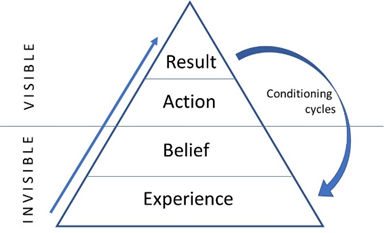
Vishu liked the concepts and started relating to his situations. I asked him, “Having identified the challenge, having understood the sources and knowing the ways to deconditioning, what would you want to do next? How would you like to overcome these challenges?”
He started noting down some action points in silence. Then he said “I will more consciously talk in meetings now on”. It was too open ended. I asked him “What situation do you envisage in the next few weeks where you can try out these points?”. He mentioned about the Monthly Review Meeting with leaders that is coming up next week. He said he will consciously ask at least one question and share at least one point of view in that meeting. I added “include at least one appreciation also, towards someone or some point”. He readily added. I was glad to see that he had also noted down practicing longer exhale breathing to deal with anxiety before such events, which was taught as part of “Leadership Courage – dealing with fear” module in Leading Self. I then kept asking him what else can he do.
He also said that he will participate in Toast Masters Club and try out some spontaneous speaking. I highly encouraged it as it is a safe platform to experiment where there is collective support & encouragement by participants and there is no fear of being judged.
He asked me how to improve English language skill. Coming from a place where only native language is encouraged, English vocabulary, grammar, expressions were a challenge for him. I mentioned that reading books helps in those developments. When he asked for a reference, I suggested him the book “Your Brain at Work” by Dr David Rock, as it would help not only in the language but also in many small practical tips on behavior change, backed by neuroscience. He immediately looked up on Amazon and placed the order.
As we approached the end of coaching session, he summarized the actions he will take before we meet in the next coaching session in 2 weeks time:
- Having become aware of the genesis, consciously let go of the inhibition and push the boundary
- Ask at least 1 question, share at least 1 point of view, give at least 1 appreciation in the next Monthly Review Meeting
- Practice longer exhale breathing to deal with anxiety
- Participate in Toast Masters Club
- Start reading the book
- Look for a public speaking opportunity to a larger audience in the organization (which I suggested at the end)
There was a sigh of relief from him, moving from a state of helplessness to state of feeling a little bit in control. He thanked profusely; I appreciated his deep engagement and wished him for his experimentations. We shook hands.
After a week we met again during the second workshop, which is focused on Leading People. Noticed Vishu was more relaxed, was interacting better with peers, was asking questions and expressing his points in the session. During the coffee break casually asked him how things are going for him. He shared similar feeling as I had observed. I gave him a positive Stroke by sharing my similar observation. His energy went up.
He enthusiastically shared that he has observed similar struggles in some of his team members and is helping them to overcome them by sharing his examples and coaching them.
He went on to share that he is more aware of how to bring up his 8 year old son now, so that he will have less of such challenges. As we were rushing back to the class, I didn’t want to miss an important point and made an unsolicited suggestion to him –“ Don’t try to ‘teach’ children; they learn more by observing what parents do, than by what parents ‘tell’ them to do. Instead, you demonstrate through your actions & behaviors, they will pick it up”. He stood for a moment with his eyes wide open. It was an ‘aha’ moment for him.
I am eagerly looking forward to the next coaching session to hear Vishu’s experiences from his experiments.