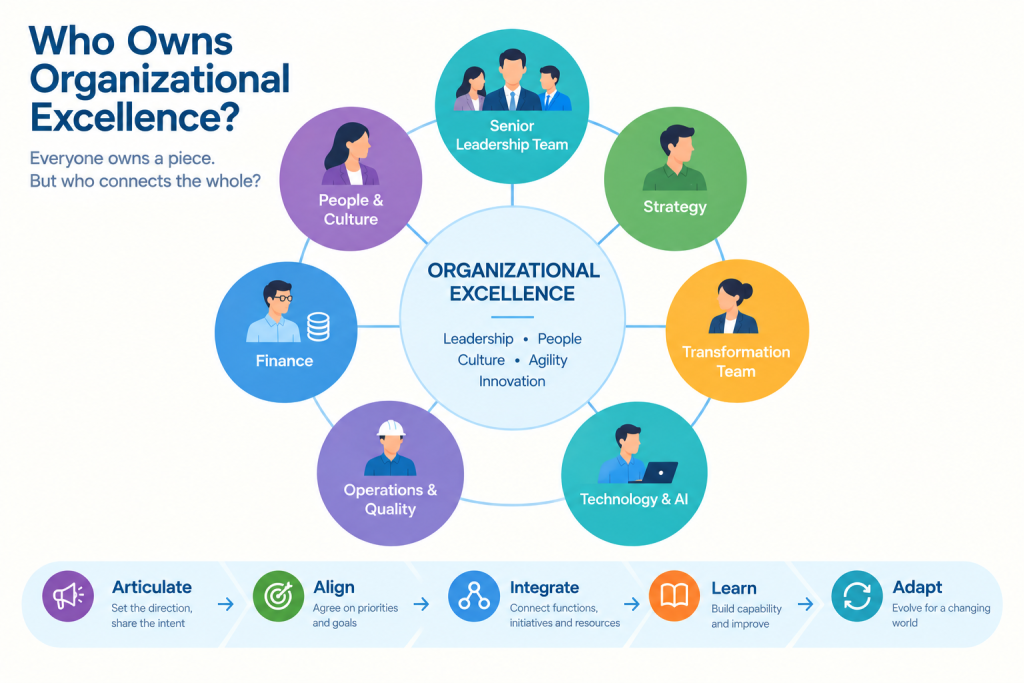



In our first article, we separated Organizational Excellence from Operational and Business Excellence. In the second, we argued that every function owns a piece of it, but accountability for the whole sits with the CEO and senior leadership.
If leadership owns it, what yardstick should they use? Is there a standard for Organizational Excellence, like ISO 9001 is the standard for quality management? Let us explore.
Is There a Standard for Organizational Excellence?
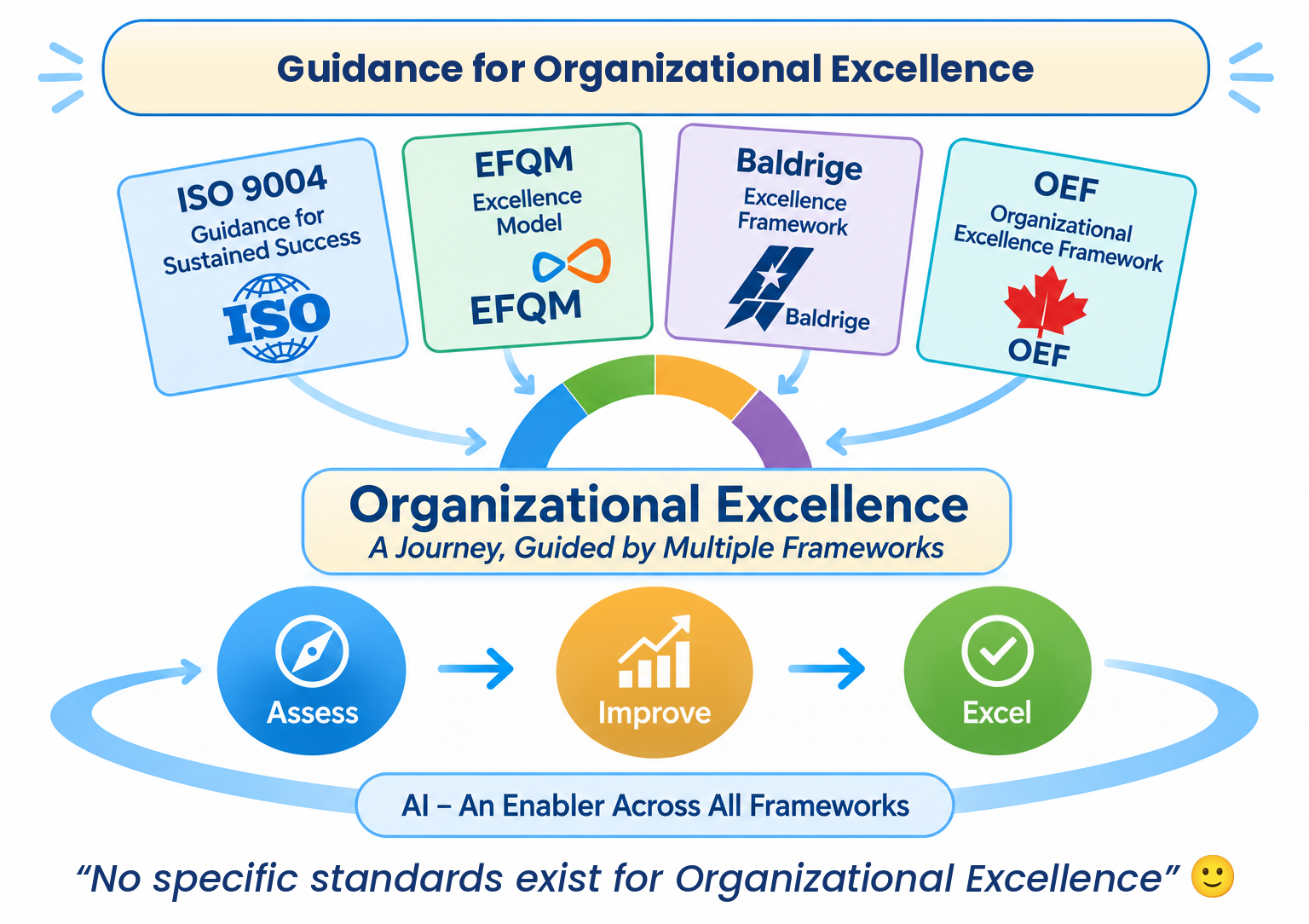
No formal standard carries the name “Organizational Excellence.” The closest is ISO 9004:2018, Quality of an organization – Guidance to achieve sustained success.
ISO 9004 is a sibling of ISO 9001, but goes further: ISO 9001 asks whether you have a quality system that meets requirements, while ISO 9004 asks whether the organization itself is capable of sustained success. It applies to any organization, whether a product company, a services firm, a GCC, a nonprofit or a government body. It also includes a self-assessment tool that rates maturity on five levels.
Also close are Excellence models, such as the EFQM Model 2025 and the Baldrige Excellence Framework. These are assessment frameworks used for national and international awards. They often blur Organizational and Business Excellence. Another model worth mentioning is the practitioner framework Organizational Excellence Framework (OEF) from Canada, which consolidates the leading models into implementation guidelines.
What Areas Do These Standards Cover?
The standards and models may vary in the terminology but they all point to the same areas we covered in the first article of this series.
| Area | Scope |
| Strategy | The Organizational context: Do we understand our interested parties and the external and internal issues that affect us? |
| Culture & Behaviors | Organizational Identity: Are mission, vision, values and culture clear and lived? |
| Leadership | Excellence: Do leaders set direction, build alignment and create trust? |
| Processes & Ways of Working | Process Management: Are processes designed, owned and integrated end to end? |
| People & Capability; Technology, Data & Knowledge | Resource Management: Are people, knowledge, technology and partners managed as capabilities? |
| Governance & Risk | Analysis and evaluation of performance: Do we measure, benchmark and review the right things? |
| Innovation & Agility; Continuous Improvement & Learning | Improvement, learning and innovation: Does the organization keep learning and reinventing itself? |
How AI Is Changing the Picture
Most of these standards were written before AI started proliferating, AI now touches every area in the table above. It changes how decisions get made, what skills people need, how teams are structured and where are the risk areas. AI is expected to substantially simplify or improve processes helping to reduce Cycle and Lead times
The frameworks are starting to catch up. The EFQM Model 2025 now gives more weight to what it calls Technology Leadership, “the ability to effectively leverage technology to achieve strategic goals”, and names AI explicitly in its criterion on innovation and technology.
The Takeaway
There is no single “Organizational Excellence standard”. If we observe the Areas above, the excellence starts with a Strategy, Organize, Execute and Improve essentially following the PDCA cycle. Each organization can have a separate approach towards PDCA and hence absolute Standards do not exist but only the guidance. How ever bench marking with other organizations in the industry helps to improve the capabilities.
The emerging AI standards add a layer that no excellence journey can now ignore. The real value comes when leadership uses them together as one integrated view of organizational capability. This is where PM Power Consulting with its vast experienced consultants, can work with organizations to achieve Organizational excellence.
(In the coming articles, we will take each dimension in turn, starting with Leadership. We will explore what excellence looks like in each area, how AI is reshaping it, and how to measure it)
References
- ISO 9004:2018 – Quality of an organization
- The EFQM Model 2025
- Baldrige Excellence Framework, NIST
- Organizational Excellence Specialists (CANADA)
*******************************************