



Delivery Managers in IT services organizations constitute the critical link between senior leadership and operational/project management levels in software delivery organizations. They play vital roles in:
· Making delivery commitments to customers and ensuring that they are met, while meeting goals for revenue and profitability
· Providing direction and support to executing teams and ensuring conformance to proven work methods & tools
· Taking forward key organizational initiatives for successful implementation and sustenance
· Developing managerial and leadership competencies

Often, people who have been successful as first line project managers or operation managers get promoted to the role of Delivery Managers. Typically, when a person moves to a higher role, the competencies that made him successful in the earlier role are not quite sufficient for continued success.
Indeed, in some cases, one may need to “unlearn” some of the work practices and management styles that were successful earlier.
For example while people management basics are the same, what it takes to manage managers is quite different from managing a team of individual contributors as a first line manager.
Another example is the ability to “assure” delivery as a Delivery Manager as compared to executing a project as a Project Manager. In other words, competencies required for a Delivery Manager cover nuanced project management as well as new areas such as growing accounts in existing accounts, interacting with senior level customer-side stakeholders, influencing peers, gaining cooperation within the organization and so on.
However, unlike in the case of Project Managers where there are definitive process frameworks and bodies of knowledge (such as PMBOK and PRINCE2), for Delivery Management, there are no direct equivalents (although aspects of Portfolio Management and Program Management are applicable to an extent).
As a result, Delivery Managers need much more of contextual help in dealing with the demands of their role. Hence coaching in their live work context is of significant value.
Also, there is much value for Delivery Managers to learn from each other as role challenges and ways of addressing them tend to follow some repeating patterns. All the above can be brought together in designing and delivering a program for the development of Delivery Managers.

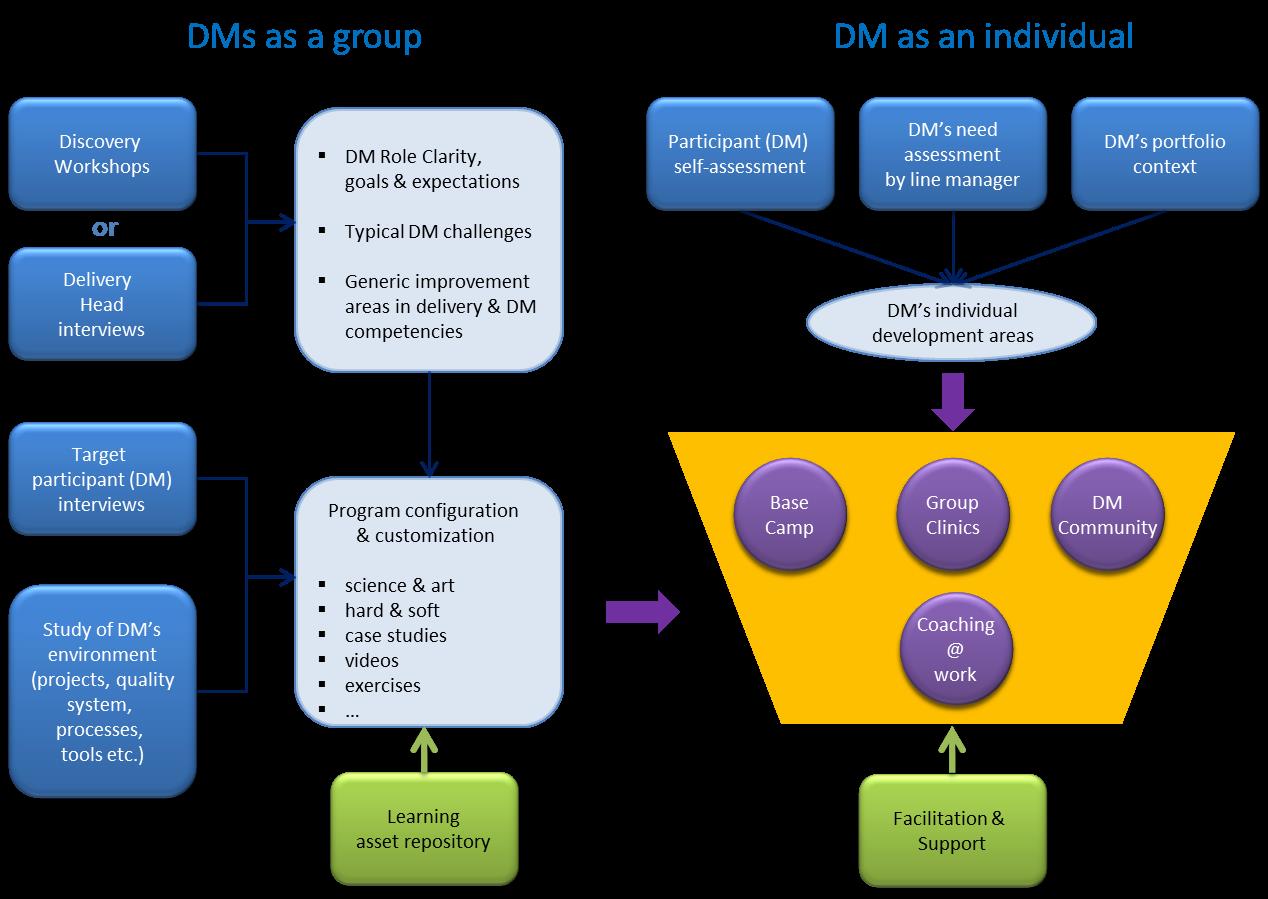
Keeping in mind the nature of the Delivery Manager role and the repeating patterns referred to above, we recommend a framework-based approach for such development programs. The schematic below shows one such framework. The major components of the framework are described further down. Some components address the target set of Delivery Managers as a group while other components address the individual development needs of Delivery Managers. The key components are described below.
Discovery

The starting point in the framework is a “Discovery” session (top left hand corner in the diagram above) with the delivery organization’s senior leadership to identify the challenges & opportunities specific to the organization and their linkage to managerial competencies. Discovery also includes one-on-one sessions with target delivery managers & their reporting managers to identify individual developmental needs.
Program configuration & customization

Based on the Discovery sessions, the program needs to be configured covering the science as well as the art of delivery management, hard & soft skills and customized learning assets that need to be created, leveraging lessons from the organization’s past projects.
Base Camp

Once the program configuration and content development (such as case studies, exercises and so on), the first group interaction can be planned – referred to as “Base Camp” in the diagram above. The goal of the Base Camp (as the name suggests) is to broadly align the target set of Delivery Managers in terms of role alignment, role expectations and “core” concepts, typically covering:
· Commitment Making
· Delivery Assurance
· Delivery Leadership (empowerment, motivation, influencing and building high-performance teams)
· Coaching & developing Project Managers

The Discovery component (referred to above) helps identify individual development needs of each of the target Delivery Managers based on their own self-assessment and inputs from their reporting managers. These form the basis for a series of one-on-one coaching sessions. This component is referred to as “Coaching@work” in the framework diagram above. These sessions focus on:
· Developing self-awareness
· Recognizing blind spots
· Identifying specific personal goals
· Acting to achieve the identified personal goals
These sessions also help address specific challenges faced by the Delivery Managers in their work context.
Group Clinic
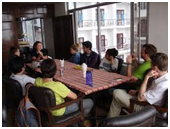
The next component, called “Group Clinic”, aims at promoting group learning from actual project/engagement challenges faced by Delivery Managers, ways of addressing them and learnings from them. There could be several Group Clinics on a regular basis, planned around specific themes such as Managing Portfolios, Driving performance through metrics, Managing large multi-service engagements, Influencing and so on. The themes are flexible and the choice should be with the participants.
DM Community

As can be inferred from the above, a development program covering all aspects of the framework does take time for a set of Delivery Managers – typically 4-6 months (depending on individual and group needs). The framework also provides for a “sustenance” component beyond the initial 4-6 month duration – a “DM Community” that would help sustain group learning and specific initiatives, say, in improving organizational delivery maturity.
Supporting components

There are also two “supporting” components shown at the bottom of the diagram described below.
“Learning assets repository”(creating and periodic enrichment of a learning assets repository could, in fact, be among the first initiatives that can be taken up by the DM Community).
“Facilitation & support” from senior delivery leaders to
· set directions for the overall program, monitor and enable course corrections
· create opportunities for Delivery Managers within the organization to practice and learn in live environments – through cross project audits, secondment opportunities, task force memberships etc.
Facilitation & Support also involves functions such as HR and Learning & Development in the organization. They need to be fully aligned with the program and organize specific training sessions corresponding to individual development areas and provide other support as needed.
If you have perspectives to share on the approach described in this post, feel free to reach us at info@pm-powerconsulting.com. We value your inputs.