


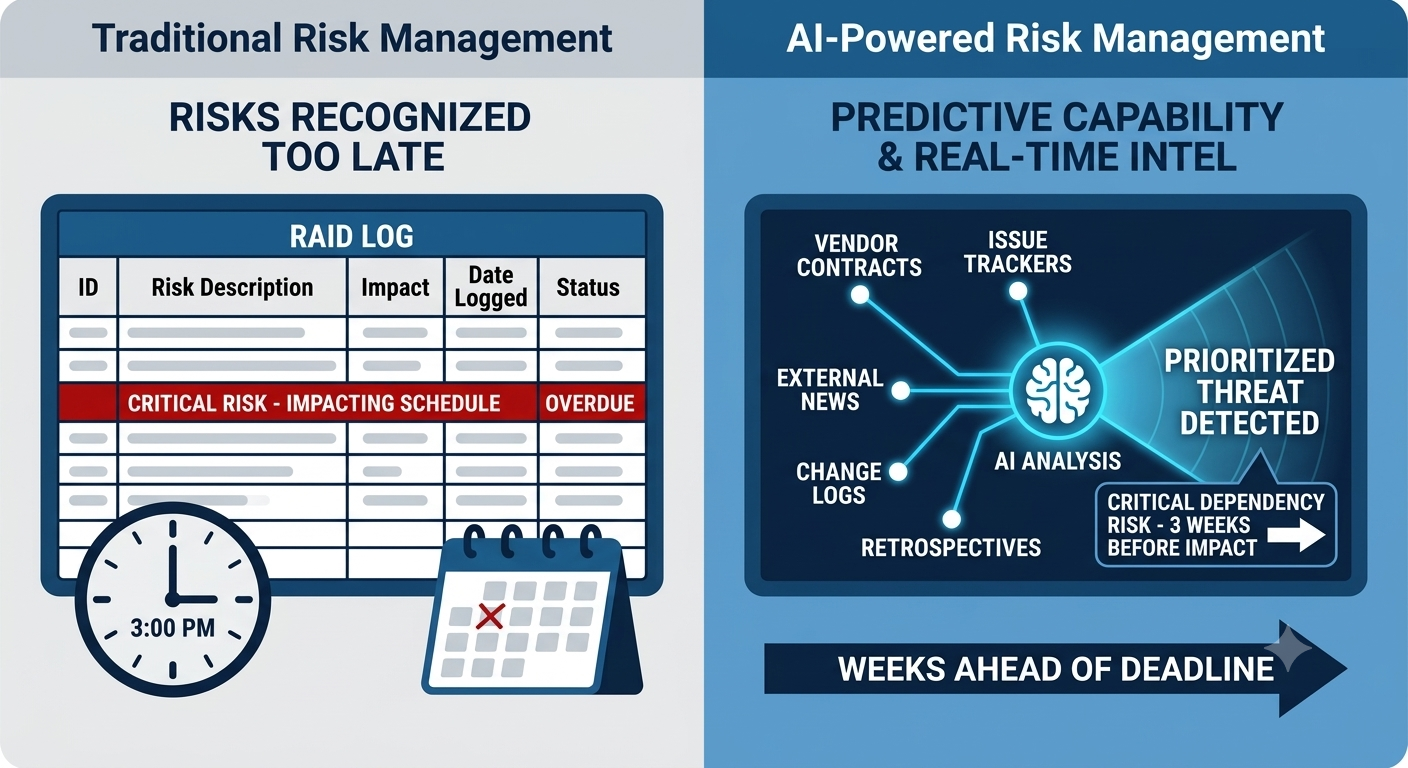
Most programs do not fail because risks are unknown. They fail because risks are recognized too late.
Think about that for a moment. Your risk register exists. Your team reviews it. Your governance is in place. And yet, by the time a risk surfaces formally — through a review meeting, a status update, a steering committee — it has often already done its damage. The schedule has slipped. The cost has crept. The window to act has closed.
That is not a process failure. That is a structural limitation of how traditional risk management works. And it is exactly the limitation that AI is built to overcome.
AI transforms risk management from a periodic, manual, reactive exercise into something fundamentally different: a predictive, continuous, real-time capability that surfaces threats before they become problems — and gives you the intelligence to act while you still can.
This is the first in a two-part series on AI-powered risk management for program managers. Part 1 makes the case for change — examining why traditional risk management struggles to keep pace, and how AI addresses those gaps through four core techniques. Part 2 gets practical — walking you through a step-by-step implementation playbook, the metrics that tell you whether it’s working, and the guardrails you need to put in place.
Let’s start with the problem. Large programs coordinate dozens of interdependent workstreams across months or years. A single overlooked risk in procurement can cascade across delivery timelines, trigger budget overruns, and put your go-live date in question — all before it appears on a risk register. Whether your program runs on waterfall, agile, or a hybrid of both, the exposure is real. For program leaders already using LLMs like ChatGPT or Gemini, the leap to AI-powered risk management is natural yet transformative.
Why Traditional Risk Management Falls Short
Most of us have been through the ritual. The workshop. The probability-times-impact scoring. The RAID log entry. The fortnightly review. It works — in stable environments, on well-understood projects, where risks surface slowly and predictably.
But that is not the world large programs operate in today.
Consider what actually happens. A regulatory framework shifts mid-delivery — as many programs discovered in 2025 when AI governance requirements emerged globally, leaving initiatives designed months earlier suddenly non-compliant. A supply chain disruption materialises in hours — a port strike, a flood, a geopolitical shock, a supplier going offline — long before the next scheduled risk review picks it up.
Agile and hybrid programs face an additional layer of difficulty. Risks in these environments do not arrive as neatly labelled threats. They surface as impediments in Scrum of Scrums, as buried assumptions in product backlogs, as dependencies that quietly shift with every Program Increment. While some parts of the program are moving fast others are moving slow. The gap between the two is where risks hide.
And across any program running multiple parallel workstreams, the sheer volume of risk signals — from issue trackers, retrospectives, emails, change logs, external feeds — quickly exceeds what any team can manually track, consolidate, and act on in time.
The result? Four structural gaps that traditional risk management cannot close, regardless of how disciplined your team is:
- Attention gaps: Traditional risk management depends on human attention — and human attention is finite, intermittent, and stretched across competing priorities. Risks that surface between reviews, outside working hours, or outside someone’s line of sight simply don’t get picked up in time.
- Experience-driven thinking: Humans are more likely to identify risks they have encountered before. This is not a failure of skill or diligence but a consequence of availability bias—our tendency to recall familiar experiences more readily than to imagine unfamiliar possibilities.
- Manual scale: Reviewing hundreds of risks across a portfolio of waterfall, agile, and hybrid workstreams routinely exceeds team bandwidth. Something always gets missed.
- Siloed data: Critical risk signals—buried in retrospective notes, impediment logs, collaboration threads, and vendor communications—often never make it to the risk register in time. The information exists, but it remains fragmented across too many sources to be connected effectively.
These are not problems you can solve by working harder. They require a different approach entirely.
That is where AI comes in.
Core AI Techniques for Program Risk Management
AI does not just speed up what you are already doing. It changes what is possible. Figure 1 shows how four interconnected AI capabilities — each accessible through the LLMs you likely already use — directly address the structural gaps above.
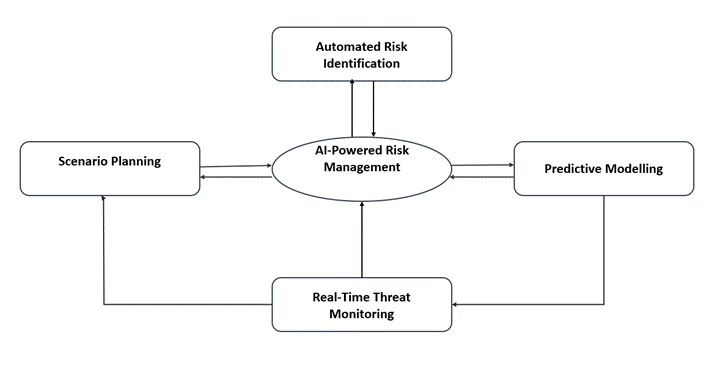
Figure 1 – Core AI Techniques for Risk Management
1. Automated Risk Identification
Imagine feeding your RAID log, your schedule summary, your vendor contracts, and your recent change requests into an LLM — and receiving back a prioritised list of latent threats with severity scores and suggested owners. Not in days. Not after a workshop. In minutes.
In an agile or hybrid program, feed your sprint retrospective summaries, impediment logs, assumption registers, and dependency maps to the AI. The AI does not just scan each document in isolation — it looks for connections across them. The vendor dependency that appears in your RAID log and your retrospective and your change log simultaneously. The assumption that has been quietly invalidated across three sprints. The pattern that no single reviewer would have spotted because no single reviewer was looking at all of it at once.
A more sophisticated approach runs through multiple steps — extracting dependencies, cross-referencing external signals like regulatory updates or supplier news, and scoring risks by exposure. The result: risks surface before they escalate. A key vendor’s financial instability, visible in publicly available signals, flagged weeks before it affects your delivery.
That is not faster risk management. That is a fundamentally different kind of risk intelligence.
2. Predictive Modelling and Scenario Simulation
What-if scenario modelling used to require a specialist, a dedicated tool, and several days of preparation. AI makes it conversational.
In a traditional program, describe your risk inputs — a delayed vendor, a resource gap, a regulatory hold — and ask the model to walk through the likely downstream impacts across your baseline schedule. Within seconds, you have a view of which workstreams are exposed, which milestones are at risk, and where you have buffer to absorb the shock.
In agile and hybrid programs, the picture is more layered. New risks emerge with every planning cycle — as each rolling wave or Program Increment brings fresh detail, dependencies, and delivery commitments into view. AI can assess the impact of a risk across all planning horizons simultaneously — the current sprint, the next Program Increment, and the longer-term roadmap — giving you a precise and layered view of when and where a risk will impact.
The question you used to spend days answering now takes minutes. Which gives you something more valuable than speed: time to decide.
3. Real-Time Threat Monitoring
Your program generates a continuous stream of risk signals. Most of them never reach you.
Integrate AI with your program ecosystem — issue trackers, collaboration tools, external news and regulatory feeds — and it monitors for risk signals continuously, not just at the next scheduled review. In agile programs, this extends to the early warning indicators that experienced delivery leads watch instinctively: velocity trends, burndown anomalies, sprint goal achievement rates, team capacity signals. A sustained velocity drop across two or three sprints is rarely just a delivery blip. It is usually a signal of something deeper — resourcing pressure, technical debt accumulating, a dependency blockage tightening. AI spots the pattern before it becomes a crisis.
For hybrid programs, AI bridges the gap that every Delivery Lead recognises: the disconnect between the fast-moving signals at team level and the slower governance rhythm at program level. By the time an impediment makes it from a sprint retrospective to a steering committee agenda, three weeks have passed. AI translates team-level signals into program-level risk language in real time — so your governance discussions are about decisions, not discoveries.
4. Scenario Planning and Decision Support
Risk management does not end with identification. It ends with a decision.
AI is well-suited to stress-testing your program against multiple futures simultaneously. Present it with disruption scenarios — a vendor delay, a team capacity drop, an unexpected scope addition — and ask it to model the trade-offs that preserve your key program outcomes. The output is not a risk score. It is a decision brief.
In agile and hybrid programs, this dimension extends further. What happens to sprint commitments, PI objectives, and team morale if a major risk materialises mid-iteration? AI models the impact across both the immediate sprint and the broader roadmap, helping you decide in minutes whether to absorb, defer, or escalate — with the analysis already packaged for steering committee review.
The time between a risk emerging and a decision being made is where programs lose their margin. AI compresses that window dramatically.
The Path Forward
The case for change is clear. AI-powered risk management is not a future ambition—it is a live capability available today through the tools you already use. The question is no longer whether AI can transform how your program manages risk, but how quickly you can put it to work responsibly.
However, understanding what AI can do is only half the equation. Realizing these benefits requires moving from theory to execution—integrating these tools into your existing governance, setting up the right guardrails, and defining the metrics that prove it is working.
That practical transition is exactly where Part 2 of this series picks up. In Part 2: Stop Reacting. Start Predicting Risks with AI, we provide a step-by-step implementation playbook, look at the essential guardrails for human oversight, and explore where agentic AI is taking program management next. See you there.