


Why Digging Deep into Personal Source of Energy is the Ultimate Lever for Leaders?
1. The Reality Shift: From Time Scarcity to Energy Scarcity
The Strait of Hormuz is the world’s most consequential geopolitical chokepoint—a narrow, fiercely contested gateway through which a massive portion of global energy must flow. If external disruptions choke that strait, global systems grind to a halt. The impact was felt in unavailability of our favorite masala-dosas thousands of kms away!
As a leader operating in a turbo-charged VUCA world, you command an equally critical gateway: your personal Strait of H. This is the narrow, internal chokepoint through which your physical, mental, and emotional energy must flow to power your execution. Right now, your fragmented calendar, continuous organizational shifts, and endless stakeholder demands are trying to seize control of this gateway and demand a toll. The most critical question for your leadership endurance is no longer how you manage your clock, but a far more strategic one: Who really controls your Strait of H?
For a long time, leadership effectiveness has been framed as a function of time: how well you allocate it, optimize it, and protect it. It is true that your calendar days are highly fragmented, and a majority of your time blocks are controlled by everybody else.
We are operating in a world where volatility is not episodic but continuous, where ambiguity is not a phase but a permanent condition. A turbo-charged VUCA environment does not just increase your workload—it fundamentally alters the nature of leadership itself. As a leader, you are not just managing operations; you are:
- Making high-stakes decisions with incomplete data.
- Absorbing systemic uncertainty from the external environment.
- Maintaining organizational coherence under sustained pressure.
This is not a time management problem making our earlier model break down. When available time is fixed for everybody, your capacity to use that time well—clarity of mind, focus, and emotional steadiness—is the true variable, and it is increasingly being depleted. It is actually a personal energy scarcity problem.
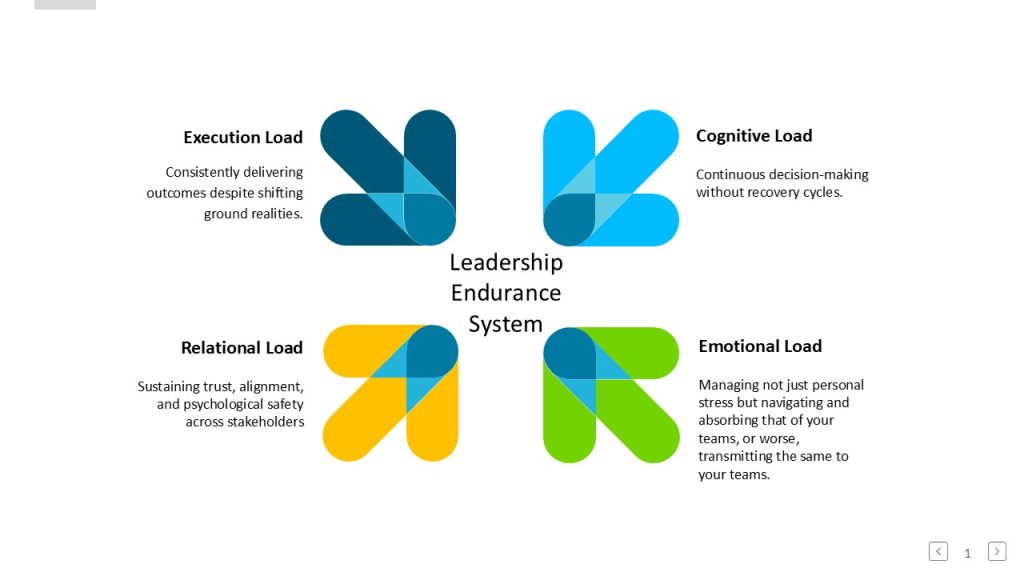
2. The Real Problem: Multiple Loads on Leadership Endurance System
In an organizational context, every geopolitical shock, market disruption, or organizational shift eventually collapses into a single point of execution: a leader making decisions under pressure. For someone stepping into greater scopes of responsibility, this creates a severe, multi-dimensional strain:
- Execution Load: Consistently delivering outcomes despite shifting ground realities.
- Cognitive Load: Continuous decision-making without recovery cycles.
- Relational Load: Sustaining trust, alignment, and psychological safety across stakeholders.
- Emotional Load: Managing not just personal stress but navigating and absorbing that of your teams, or worse, transmitting the same to your teams.
Most leaders respond to this strain in the only way they know how: they push harder. More hours. More effort. More intensity. For a while, this raw stamina compensates, until it doesn’t. What looks like commitment on the surface is often unsustainable energy extraction underneath. Burnout, in this context, is not a personal failure or an anomaly. It is a systemic outcome of mismanaged energy under sustained volatility.
3. Leadership Personal Mastery
To survive and thrive, you must shift your paradigm: leadership effectiveness is not a function of efficient time management, but of energy availability and energy architecture.
Consider this central construct of the Personal Performance Equation:
Personal Mastery = fn (Outer Mastery, Inner Mastery)
- Outer Mastery (External Delivery): Your skills, execution systems, and delivery discipline.
- Inner Mastery (Internal Capacity): The internal energy system that powers those capabilities.
Many leaders focus almost exclusively on Outer Mastery. They love to become better at business strategy, execution models, operational efficiency, productivity, business acumen to name a few. But in a turbo-charged VUCA world, Outer Mastery without Inner Mastery leads directly to burnout, while Inner Mastery without Outer Mastery leads to inefficiency. Sustainable leadership requires a deliberate, balanced integration of both.
4. The Core Reframe: From Time Management to Energy Management
To move from abstraction to application, we define the Energy-Management System as a two-part system that integrates your internal capacity with your external delivery. I will de-code the same.
4.1 The Execution System (Outer Mastery)
This is where most leaders over-index upon. True execution is not about frantic effort; it is about reliability. It is not heroic, sporadic output, but predictable delivery. This requires shifting from reactive activity to deliberate structure:
- Defined priorities
- Clear workflows
- Consistent follow-through
In complex corporate systems, unpredictability creates friction. Leaders who can design their own work systems to reduce friction create disproportionate value. Such a work system can be designed as follows:
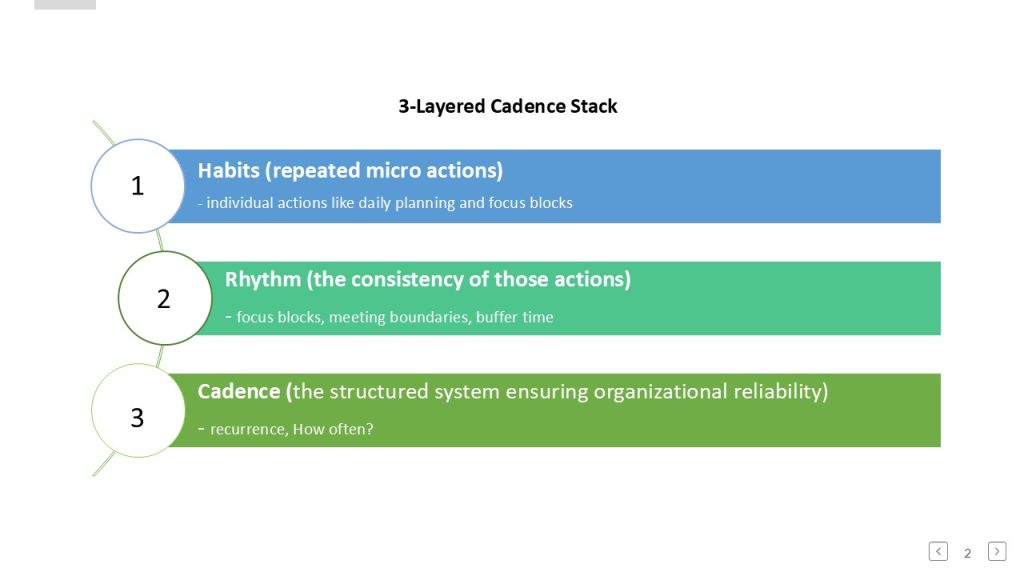
- The Cadence Stack (Operational Rhythm): Execution becomes sustainable only when it is rhythmic. We define this through a three-layer construct: Habits (individual actions like daily planning and focus blocks) power your Rhythm (the consistency of those actions), which scales into a Cadence (the structured system ensuring organizational reliability). A calendar tells you what to do; a cadence ensures it actually happens—consistently.
- The Focus Architecture (Managing Cognitive Load): One of the biggest hidden drains on a leader’s energy is context switching. What is often celebrated as multitasking is actually rapid task-switching paired with a heavy cognitive penalty. Each switch consumes vital mental energy and reduces effectiveness. The alternative is a strict Focus Architecture: utilizing dedicated Focus Blocks (e.g 45–90 minutes), committing to serial rather than parallel processing, and embedding intentional recovery intervals. This is not about doing more work in less time but doing better work with less energy leakage.
4.2 The Inner Energy Sources: Navigating Your Personal Strait of H
While the outer mastery is important to achieve, what can truly be a differentiator is your Inner Energy System. If your calendar and workflows represent your external shipping lanes, this inner system is your personal Strait of H—a vital, narrow chokepoint through which all your execution power must flow. No external stakeholder can seize control of this strait or demand a toll unless you allow them to.
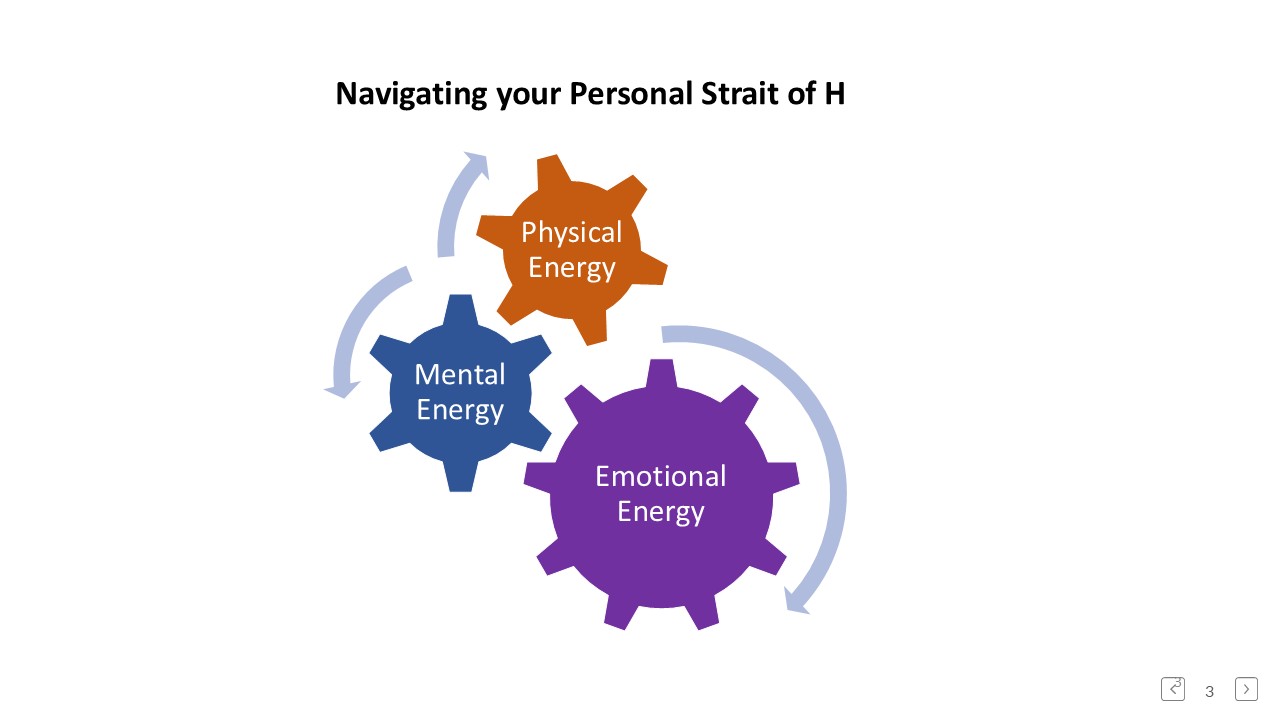
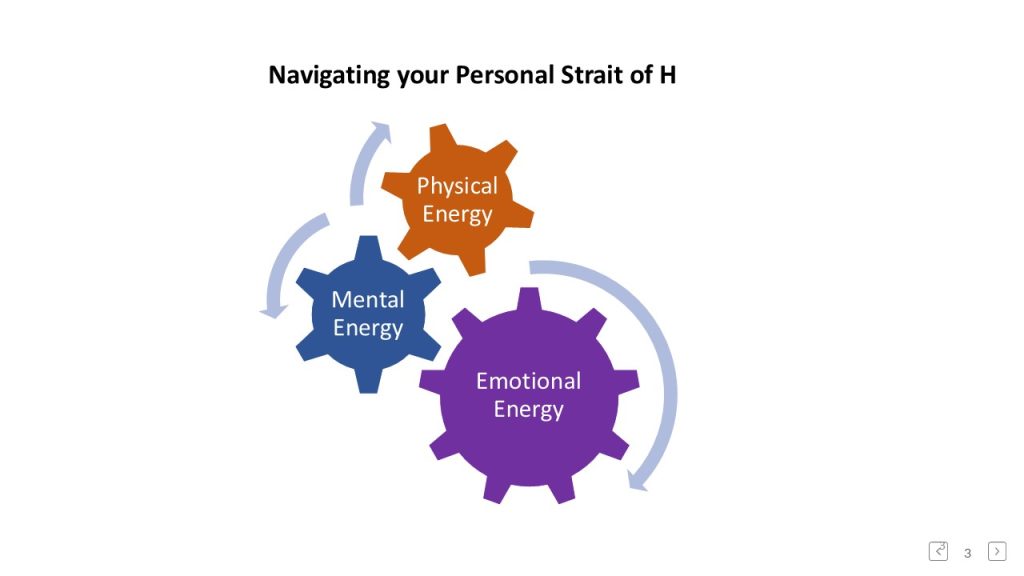
Managing this internal gateway is your sole responsibility. Rather than viewing it as a fragmented checklist of to-dos, you can visualize this as an integrated, three-gear engine:
- The Physical (The Biological Base – body): This is your foundational capacity—the raw biological currency generated by sleep discipline, nutrition, and movement. It determines your baseline stamina and physiological resilience. Without physical stability, all higher-order cognitive and emotional performance eventually collapses.
- The Mental (The Cognitive Bandwidth – mind): This component dictates your focus, attention span, and decision-making bandwidth. It drives high-quality strategic thinking under intense pressure. When your attention is constantly fragmented, your mental energy leaks, leading directly to degraded, reactive decisions.
- The Emotional (The Stability Regulator – emotion): This component governs your psychological state, response patterns, and leadership presence. Leaders do not operate in a vacuum; you do not just carry your own emotions—you actively regulate the emotional climate of not only your own team but also all stakeholders you interact with. Your emotional stability shapes trust, alignment, and your ultimate relational impact.
Watch out for the Hidden Trap: The Interdependency
The critical mistake most leaders make is treating these as three independent silos. They are not; they form a single, highly integrated system. When one component depletes, the others instinctively step in to compensate, until they can’t.
If you are running on four hours of sleep (Physical Depletion), your brain pumps out adrenaline, forcing your Mental gear to hyper-focus through sheer willpower to get you through a presentation. If you are enduring sustained organizational uncertainty (Emotional Strain), your body absorbs the tension, quietly draining your Physical stamina.
This compensation mechanism creates a dangerous illusion of competence. You convince yourself you are “handling it” because the work is still getting done. In reality, you are running an unsustainable energy extraction deficit. The system will mask its own decay quietly—until the crash happens. When it does, the entire Strait of H chokes, and performance degrades quietly, then suddenly.
5. The Strait Insight: Energy Is a Force Multiplier
Your energy state (by your active management) does not just affect your personal performance; it amplifies or distorts everything you do as a leader.
| When Energy Sources Deplete / Collapse | When Leaders Operate with High, Stable Energy |
| Decisions become short-sighted and reactive | Decision quality and strategic clarity improve |
| Stress and anxiety cascade downward to the team | Emotional contagion becomes intensely positive |
| Teams burn out compensating for leadership gaps | Teams experience clarity instead of confusion |
| Performance degrades—quietly, then suddenly | Execution becomes smoother, predictable, and less strained |
6. The Leadership Imperative
We often talk about resilience, agility, and adaptability as core leadership capabilities. My view is that these are not innate personality traits. They are the direct, measurable outputs of a well-managed personal energy system.
In a world where volatility is external, systemic, and entirely uncontrollable, your only true lever as a leader is your internal performance environment.
As a leader, the question that will define your career trajectory is no longer: “How do I get more done?”
The only question that matters is: “What internal state must I operate in for my best thinking, judgment, and leadership to show up consistently?”
7. A Practical Adoption Pathway
Here is a practical Adoption Pathway to Leadership Personal Inner Mastery: From Awareness to Systemic Discipline. This can serve as an operating model re-designed at a personal level. To move from chronic depletion to sustainable high performance, you can consider transition through five distinct, sequential phases:
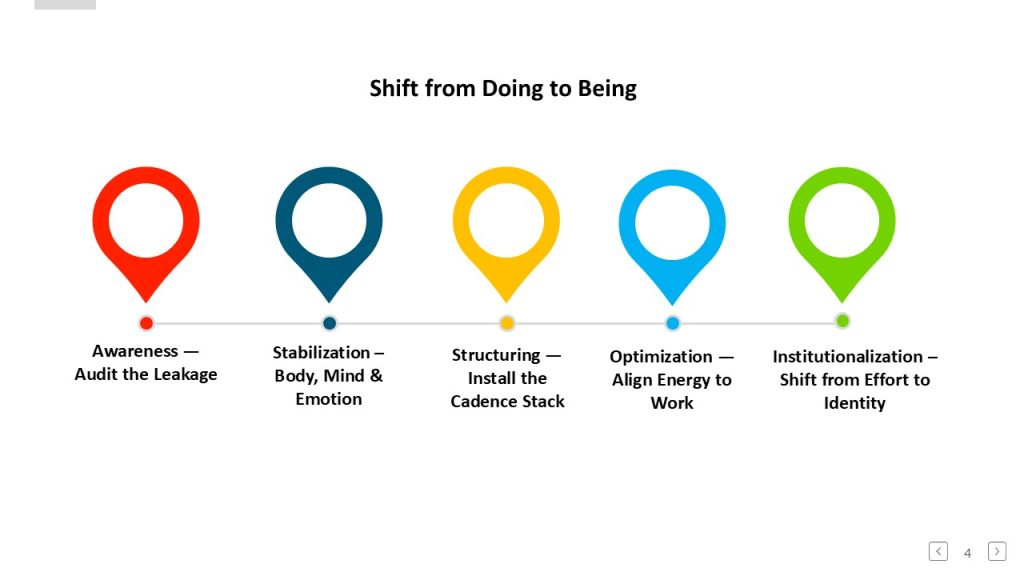
Phase 1: Awareness — Audit the Energy Leakage
Before you can optimize your system, you must map its friction points. The objective here is to shift your primary diagnostic metric from time availability to energy availability.
- Possible Action: For one week, track your transitions rather than your tasks. Diagnose exactly where your energy is leaking across your physical, mental, and emotional layers. Identify the specific meetings, habits, or interactions that act as net-drains.
Phase 2: Stabilization – Body, Mind & Emotion
Optimization is useless if your core infrastructure is collapsing. You cannot engineer a high-performing cognitive architecture on a foundation of physical exhaustion. This phase is strictly about stabilization, not perfection. The same rule applies for mental or emotional exhaustion.
- Possible Action: Establish strict baselines for physical, mental recovery and emotional well-being. (e.g implement digital boundaries, lock in basic movement rules to protect your foundational stamina)
- Mental and Emotional well-being through Mindfulness Techniques
Phase 3: Structuring — Install the Cadence Stack
Intent without architecture is just a wish. In this phase, you build the structural scaffolding that converts your energy goals into automatic, systemic behaviors. You are shifting from managing random tasks to deploying a predictable behavioral system.
- Possible Action: Formally integrate a daily planning rhythm, weekly review loops, and dedicated focus blocks directly into your calendar. Designate uncompromised blocks of time for deep, sequential work.
- Install a set of Mindfulness Routines
Phase 4: Optimization — Align Energy to Work
Once your cadence is stable, you can begin matching your cognitive load to your internal biological and psychological rhythms, eliminating the high energy cost of poorly timed execution.
- Possible Action: Chronologically match your peak energy periods to your highest-cognitive, highest-stakes tasks. Conversely, relegate low-value administrative items to your natural energy troughs, and design deliberate recovery intervals throughout your day.
- Pay attention to your Emotions by labeling them and making conscious shift from Reacting to Responding to situations and interactions
Phase 5: Institutionalization — Shift from Effort (Doing) to Identity (Being)
The final frontier of leadership endurance is automation. You stop “trying to manage energy” and simply execute your life through a designed system. It shifts from a conscious effort to your default identity.
- Possible Action: Standardize your operating model thoroughly that violating a focus block or skipping a recovery interval feels like an operational failure. Your energy architecture becomes an invisible, highly reliable infrastructure that powers every external delivery.
- This is truly shifting from Doing to Being
8. A Final Reflection
The most consequential energy crisis of our time in leadership is not geopolitical. It is personal.
It won’t show up on your company’s operational dashboards, but it is glaringly visible in compromised decision quality, fractured team morale, and organizational drift.
Unlike global energy networks, this system is entirely within your sphere of control. If leadership is an endurance system, energy cannot remain an afterthought; it must become your core discipline.
If you were to redesign your leadership operating model today—not around the hours on your clock, but around the energy in your system, what would you stop, start, and structure differently?
Would love to hear from you!