


Operational Excellence or Organizational Excellence (or Business Excellence)?
Ask any software company what makes them excellent, and you will hear about their tech stack, their great engineering talent, or their product’s availability. Organizations have also spent decades improving processes, reducing waste, and strengthening operational performance. But there is a bigger question worth asking: are we only improving the way work gets done — or are we improving the organization that does the work?
Clearly, the answer must go beyond simply improving our ways of working or improving our organization in isolation. This is where we need to understand the different approaches to Excellence.
Three Perspectives on “Excellence”
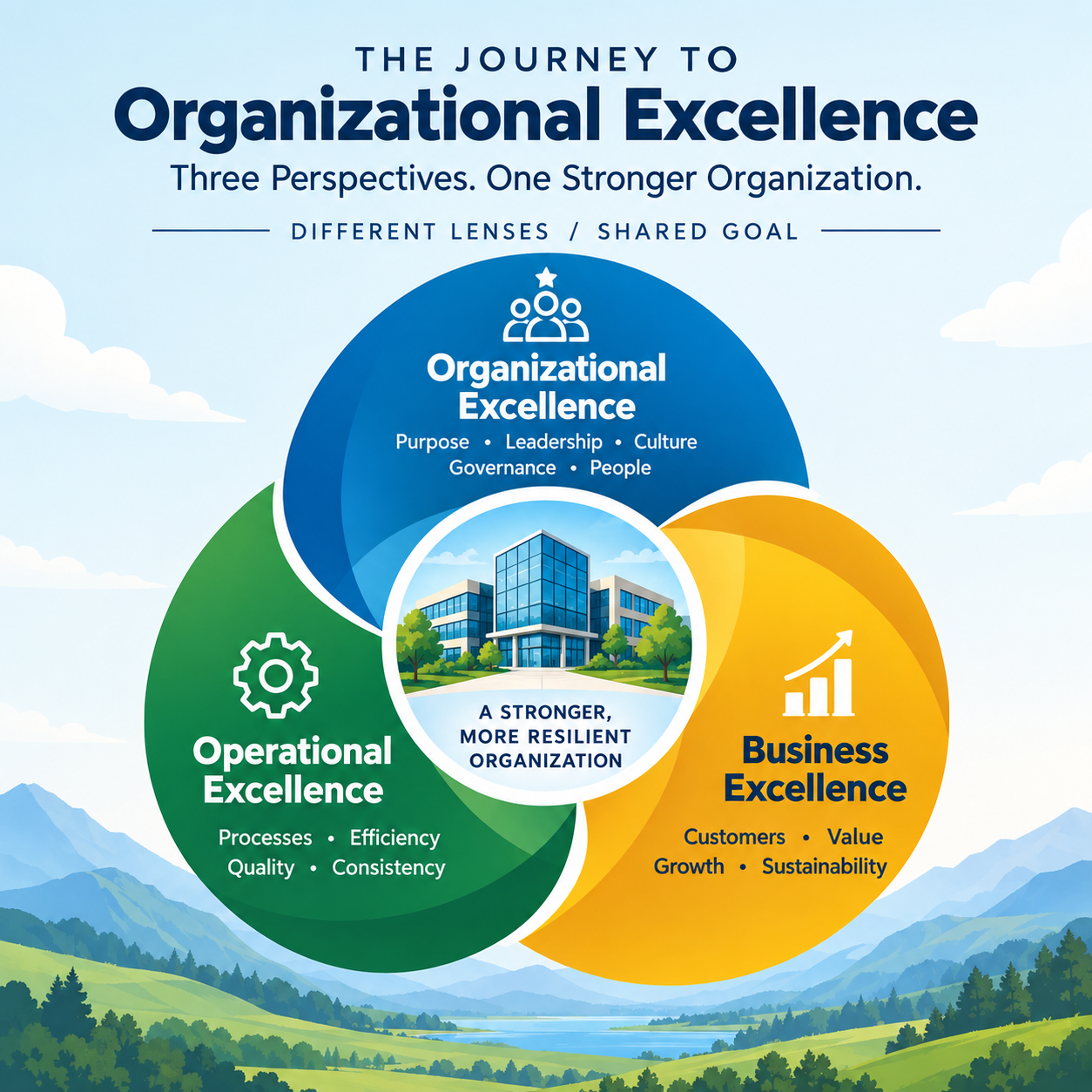
Every organization strives for Excellence to answer three questions:
“How can we do the work better?”
Actions here lead to Operational Excellence.
Focused on process, quality, cost, cycle time, standardization, and so on — Operational Excellence improves execution.
“How can we build an organization that is better at doing the work?”
Actions here lead to Organizational Excellence.
Focused on Leadership, People, Structure, Culture, Decision-making, Ability to adapt, and more — Organizational Excellence improves organizational capability.
“How can we consistently create superior, sustainable business results?”
Actions here lead to Business Excellence.
Focused on outcomes like growth, profitability, customer value, and market position — Business Excellence improves sustainable outcomes.
Organizational Excellence for Software Development
Global frameworks like EFQM and the Malcolm Baldrige Model have shaped this thinking for decades, largely in manufacturing and traditional industries. But software — both product and services — has its own version of this story.
Software companies often equate technical excellence with organizational excellence. A brilliant engineering team or a technically sound delivery model can create a false sense of security. We have seen organizations with world-class engineering talent still struggle with:
- Leadership misalignment that slows decision-making as they scale
- High attrition despite strong compensation, because career growth and culture were not designed deliberately
- Delivery excellence in isolated pockets, with no consistency across teams
- Strong products with weak governance, making rapid scaling risky rather than empowering
None of these are technology problems. They are organizational ones.
What Makes Up Organizational Excellence
There is no single universally accepted model, but an excellent organization typically shows strength across several interconnected dimensions: Strategy, Leadership, People & Capability, Organization & Operating Model, Culture & Behaviours, Processes & Ways of Working, Decision Excellence, Technology/Data/Knowledge, Governance & Risk, Innovation & Agility, and Continuous Improvement & Learning.
Increasingly, AI cuts across all of these — changing how people work, how decisions get made, and even how organizations are structured. For example, an AI-Native Software company would predict user needs, Forward Deployed Engineers would understand the requirements at the Customer premises and develop and deploy the software. Leadership would look at real-time metrics and course correct as needed; organization would be flatter and Agile ways would move to Continuous deployment breaking sprint boundaries etc.,
Why This Matters More for Mid-Size and Growing Companies
Large enterprises often have the resources to absorb organizational inefficiencies, at least for a while. Mid-size and growing companies do not have that luxury — every gap in leadership clarity, process discipline, or talent strategy shows up directly in growth, client retention, or valuation. And unlike a product bug, organizational gaps rarely show up on a dashboard. They surface as attrition spikes, missed targets, or client dissatisfaction — often too late to course-correct quickly.
So, are organizations unaware of this? Not really. Most already work on many of these elements, just under different names and different functions: Leadership owns leadership development, HR owns culture and capabilities, Operations owns process excellence, IT owns automation, Finance owns performance management, Risk owns governance. Each may be doing an excellent job within its own domain. But who owns the excellence of the organization as a whole?
This is where Organizational Excellence often gets addressed indirectly rather than explicitly. The result can be a paradox: we may have excellent processes, excellent technology, excellent people, and excellent functions — yet not necessarily an excellent organization. There is a need for Alignment across the organization towards Goals and a good integration ensures a sustainable operating system. The real opportunity is to connect these pieces deliberately — to build an organization that can perform, learn, adapt, and continuously reinvent itself
And in an age where AI is beginning to change not just processes but the nature of work itself, that question becomes even more important.
(In the next few articles, we will explore more on Organizational Excellence).