



The Scrum Master (SM) has to ensure that the Team meets the delivery commitments on a sustained basis. For that the SM has to enable the team members to focus and perform. SM has to do this as a facilitative leader and not as a traditional directive leader. This is a challenging scenario for a new SM or for a team where there have been significant changes in the team composition. What approach should the SM take in helping team members to achieve the required level of performance. Here is an approach and a technique that I have found useful in my experience.
Thanks to my colleague Paramu for his last blog, which triggered my thoughts for writing this blog.
Here is a scenario from SM Meena, who has taken up the role a few weeks back.
Satheesh, a new team member provided his update and said though facing a challenge with a library, he expected to resolve and complete the task soon. The update on the next day was along the similar lines with more confidence. The third day he said that he is not able to resolve. Meena was caught by surprise, on looking into it, she found that Satheesh was stuck all along. Now with hindsight, she felt that she should have taken a different approach.
Meena was restrained, as a few days back her asking an open-ended question, on the outlook for a challenging task, elicited an irritated response from Akash. This came thru loud and clear even in the in the on-line daily scrum; Akash was one of the senior-most in the team. This had dampened her enthusiasm a bit and she decided to tread cautiously.
As a coach you may have been approached with a similar situation by the SMs or sometimes by the team member.
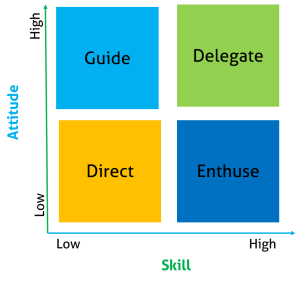
They key is that the SM has to adapt an approach that is specifically tailored for the team member and that helps bring out the best in her. A technique Skill Attitude Matrix comes in handy for this. In this technique one must map each of the team members on two axes of Skill and Attitude.
Skill Attitude Matrix
Skill being the competency of the person for performing the task at hand. This is acquired by learning and practice and honed over a period of time.
Attitude can be seen as the motivation and perseverance the person has for accomplishing the task. This will depend on her skill, interest, engagement and may be impacted by the personal situation.
The mapping is subjective and based on what the SM knows about the person, which may be limited or even biased. Even if subjective, the technique would bring in that focus on the part of the SM towards individual team member needs. That itself, in my experience, can be quite impactful
-
The SM can adopt a directive approach for people with low skills and attitude, this could be a person new to the team, work or organization.
-
For persons who have good skills and lacking in attitude, the SM needs to ascertain the cause for the same. He could address that himself or take help of the person’s manager. Most of the times acknowledging and appreciating the team members impact on the team and aligning her to the goal would work.
-
For persons who have great attitude and lack on skills, providing the required training, guidance and making available a go to person for required help will work. Often one can associate an experienced team member as a mentor.
-
The last category you do not have to do much, empower them to go about their work. SM could see that they remain in the same quadrant by ensuring that they are engaged and challenged.
SM has to bear in mind that he is not the manager and take help / consult the manager of the person as required. SM should focus on ensuring the team member performs and leave the developmental aspect to the manager.
Origins and variations
This is an interesting approach and there are a few variations of this. It doesn’t matter what you follow as long as you are focused on the outcome of providing the required help to the team member to deliver as part of the team.
The Situational Leadership is attributed to Ken Blanchard and Paul Hershey, which was introduced in their book.
It has been refined and has evolved over the years. There is a Situational Leadership model attributed to Daniel Goleman
Please see more here
Another approach termed Skill-Will Matrix and attributed to Max Landsberg and his book The Tao of Coaching.
Would love to hear your views and experiences on the same. Do give a shot at answering the Challenge of the week (CHOW)


9 Responses
An interesting “angle”! There is usually an emphasis on empathy among team members for better team work and self-organization. Would teams truly consider the manager/leader also as part of the team? Needs some mindset change. I think Emotional Intelligence training/coaching should bring out this aspect – that EI (Empathy being part of it) does not draw boundaries of applicability! Enjoyed reading a refreshingly different blog…
Thanks, Shiv. Yes, completely agree with your point on EI’s role in this regard. Gopal
Nice angle! And nice twist in the title of the blog!
Good perspective, which is normally missed.
🙏
Nice article, Gopal.
We all know one filed where downwards empathy is hardly ever seen, but upward empathy is expected and demanded. Politics.
😁
Nice article, Gopal! Very good insight. Practicing Empathy needs an effort as it needs seeing the world from the perspective of the another person. It is all the more difficult when you do not see everything that the other person sees. I remember one instance in my life when a manager reporting to me was promoted to senior manager’s post and moved away from me on a new, higher level assignment. After a few days she came to meet me and I enquired how she was doing on the new role. She said, “Milind now I know the kind of pressure you faced from above. You never passed that onto us and kept us shielded. Now I know how difficult your role and life is. I am trying to be like you!” So, the true empathy comes out of having experienced similar situations yourself.
So, Milind is the message “a little empathy is better than a late empathy”?
Gopal,
Nice blog.
This is a very valid and necessary perspective that everyone should have.
Somehow, in most organizations, just like ‘agile’ is considered as something for the teams and team members, these may be labeled as management and only for managers – as part of the leadership development plans.
Some ways how I have contextualized this in some situations:
• At an individual contributor level: connecting to empathy as a key skill for design thinking [observing and understanding users]
• At a team level: the togetherness and one-team idea [teams making commitments, the huddles in cricket and other sports etc], to use daily standups, for example, to recalibrate oneself after sensing how the others feel on that day or in a particular situation
• For managers: understanding and doing what they can, to make their managers successful, particularly when the complaint is that my manager does not understand me or my needs