


This article is part of the series on “Journey of a coach” covering my experiences as a performance coach. You may have the read an earlier article in the series on “Journey of a coach – the beginning”. The journey continues here…
Yogi Berra, New York Yankees baseball player (arguably the best catcher of all time) said, “In theory, there is no difference between theory & practice. But in practice, there is!” So, this article is about the theory & practice of coaching for performance – not baseball players but people managing software projects.
In my context, the “theory” was mostly “Coaching for Performance” by John Whitmore (by the way, there is another article of mine on Whitmore if you are interested). The “practice” was, of course, my actual experiences over the years.
A caveat – I am not here to debunk theory and hail practice – as a cardiac surgeon might! I have a great deal of respect for Whitmore’s book on Coaching for Performance. The book provided a solid reference and a practical guide for my work as a coach all these years.
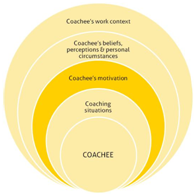
However, I do have my own “interpretations” and “extensions” of the theory in actual practice which I wish to share. I will use the diagram below which shows the context for coaching.
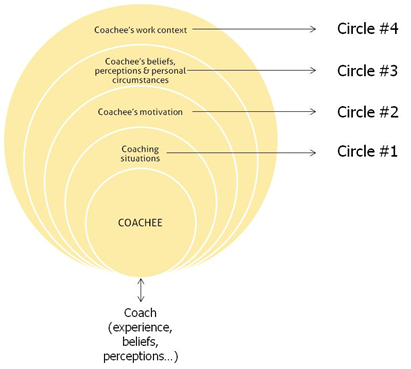
You can see the “circles of influence” around the coachee which would have a bearing on coaching and its effectiveness. We will cover each of these circles with examples. Note that the coach’s experience, beliefs and perceptions are also significant in the context in addition to his skills for coaching.
Circle #1: Are all situations “coaching situations”?
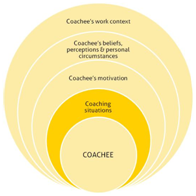
The first circle of influence is the coaching situation faced by the coachee at work. For example, it could be that he is recently promoted and finds gaining acceptance in his team a challenge.
The question is whether all such work situations are amenable for coaching – whether you are the manager of the coachee or an external coach. If you follow the “theory” (that is Whitmore), a coaching style can become the default management style of the entire organization for all occasions.
In other words, all manager-reportee interactions can naturally follow the coaching style – the manager following the sequence of helping his reportee to identify the goal he is seeking to achieve, assess the current state of affairs, consider the available options to achieve the goal and making the commitment-making to make it happen.
That is all very well, but what if you are a commando fighting a guerrilla war in a jungle and see a metal tube from the foliage pointing at you. Your commander (“manager”) is not going to coach you through the situation, is he?
There are also other equivalent (but less extreme) situations at work when time is of essence and all that the coachee needs is information or simple direction (like for example, how to balance staff loading in a project schedule).
So, my interpretation of theory is that there is better pay-off of coaching in some situations than others. However, there are many, many work situations wherein the quality of work or results is very important, the learning for the coachee very important and it is not an emergency. Coaching is very relevant in those cases.
Circle #2: Are people always receptive to coaching?
The next circle of influence is relating to how receptive people are to coaching even if their work situation was amenable for it.
Are they motivated enough to become more aware and take responsibility by themselves and not just because their employer has enrolled them in a training & coaching program?
Maslow’s theory is that motivation is linked to the stage an individual is at in a hierarchy of needs (see diagram below from Whitmore’s Coaching for Performance). Note that Whitmore has split Maslow’s Esteem stage into two – Esteem from others and Self-esteem.
At the stage of Esteem from others, one is looking “external” recognition and prestige as motivators. At the stage of Self-esteem, external motivators tend to become less important. More important is the need to make a difference and being empowered to do so enhancing self-esteem. This self-esteem stage is where coaching makes the biggest impact for personal growth.
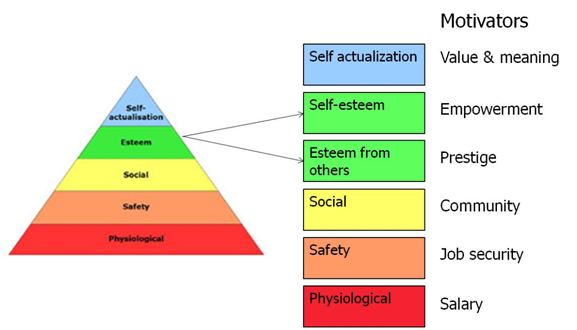
Source: Coaching for Performance by John Whitmore
There are a few more “circles” to cover which we will in Part II of the article.
Till then…